RG242 Files: The Day Kim Il-sung’s Voice Fell Silent

North Korean leader Kim Il-sung makes a radio announcement at the start of the Korean War in June, 1950. | Image: Internet Archive.
North Korea remains one of only a few countries in the world in which no privately-owned news media is permitted. All newspapers, television and radio stations are operated by the government or state agencies, the Workers Party of Korea (WPK), and the Korean People’s Army (KPA). Despite the state’s totalitarian aspirations, in its early years in the 1940s the Kim dynasty and WPK did not in fact exert full control over the news media. This essay looks at a rare instance of active dissent in the ranks of the North Korean news media from the files of the National Archives and Records Administration (NARA) in Maryland, the US.[1]
On 15 August, 1947, the then emerging leader of North Korea Kim Il-sung delivered a speech to mark the second anniversary of Korea’s independence from Japan at the end of World War II. At the time, Liberation Day was the main national holiday in the North.
Yet the broadcast was deliberately sabotaged by the manager of the Pyongyang Central Radio Station’s branch in Oyang-ni, Kim To-hok, resulting in a four-minute-long blackout of Kim Il-sung’s speech.
A subsequent WPK inspection of the radio station two months later by the chairman of the Central Inspection Committee of the Party, Chang Sun-myong, found that Kim To-hok had initiated the blackout not to target or block Kim Il-sung, but rather to frame a colleague, Pyon Ik-chu, chief of the station’s technical bureau. An investigation and subsequent report found:
He (Kim To-hok) purposely cut the speech off the air for four minutes and blamed it on Pyon. This interrupted the listening of a great many people throughout Korea and revealed anti-Party and reactionary tendencies. The incident brought disgrace to the North Korea broadcasting system. Kim thus engaged in serious subversive activity.
The actions taken by the Party to reform the radio station demonstrate both the penalties for subversion within the emerging North Korean media, and efforts by the Party, led by Kim Il-sung, to place trusted operatives in key propaganda positions as the new leader bolstered his fledging cult of personality.
The inspection report found that the perpetrator, Kim To-hok, “made remarks to the effect that if his offense were discovered, he would be discharged from the Party and that in such an event he would go to South Korea”. The report continues that the suspect was indeed “expelled from the Party” and further denounced as an “anti-Party reactionary”. Kim To-hok had been an early member of the Party, joining in Haeju City in November 1945, just three months following independence from Japan.
The report also documented instances of corruption. According to the internal investigation, senior staff were selling off paper and tires owned by the radio station for their own financial gain. Seeking a pattern behind the selfish actions, the report noted that “80 percent of the staff were formerly employed by the Japanese”. At the time, North Korea was actively trying to bar Japanese and their purported collaborators from key positions.
The radio station inspection report concluded with imperative language:
All Party members in Pyongyang Radio Station must be on the alert against elements of failure, subversion and reaction. Members must relentlessly practice self-criticism and mutual criticism, and maintain firm leadership of and cooperation with the employee. The political training program within the Party must be intensified in order that members will be ideologically firm and consistent. All members must fight for these improvements.
This raft of reforms would be enforced by Pyongyang City Party chief of the Propaganda and Agitation Section, Lee Chang-hyop, with the help of the Central District Party chairman for Pyongyang, Kim Kwan-sik. Such a serious problem could not be left to municipal officials alone, however, meaning that the chief of the Central Party’s Propaganda and Agitation Branch, Kim Chang-man (김창만), “will take charge”. According to North Korea scholar Andrei Lankov, up to the late 1950s, Kim Chang-man had been a “rising ideological czar in the regime”.[2] He was part of the ‘Yenan faction’,[3] a group of returning Koreans who had spent time in China with the Chinese Communist Party (CCP). He had served as a political officer in China and, just prior to Korea’s independence from Japan, as a propagandist in Manchuria. Upon returning to Korea, he quickly became a Party member and key figure who helped develop Kim Il-sung’s early cult of personality.[4]
Radio had already proven to be a key medium in the development of Kim’s political persona by 1947. Two years earlier, during the period just after the end of Japanese rule, Soviet-run north Korea had started operation of Pyongyang Broadcasting Station to coincide with Kim’s first political speech at a sports stadium, flanked by Soviet officers.[5]
When North Korea went to the polls for the first time the following year on 3 November 1946, radio and on-air “slogans” were raised by the Soviets in Pyongyang as a key propaganda tool on the first day of the vote.[6]
Restricted Radio
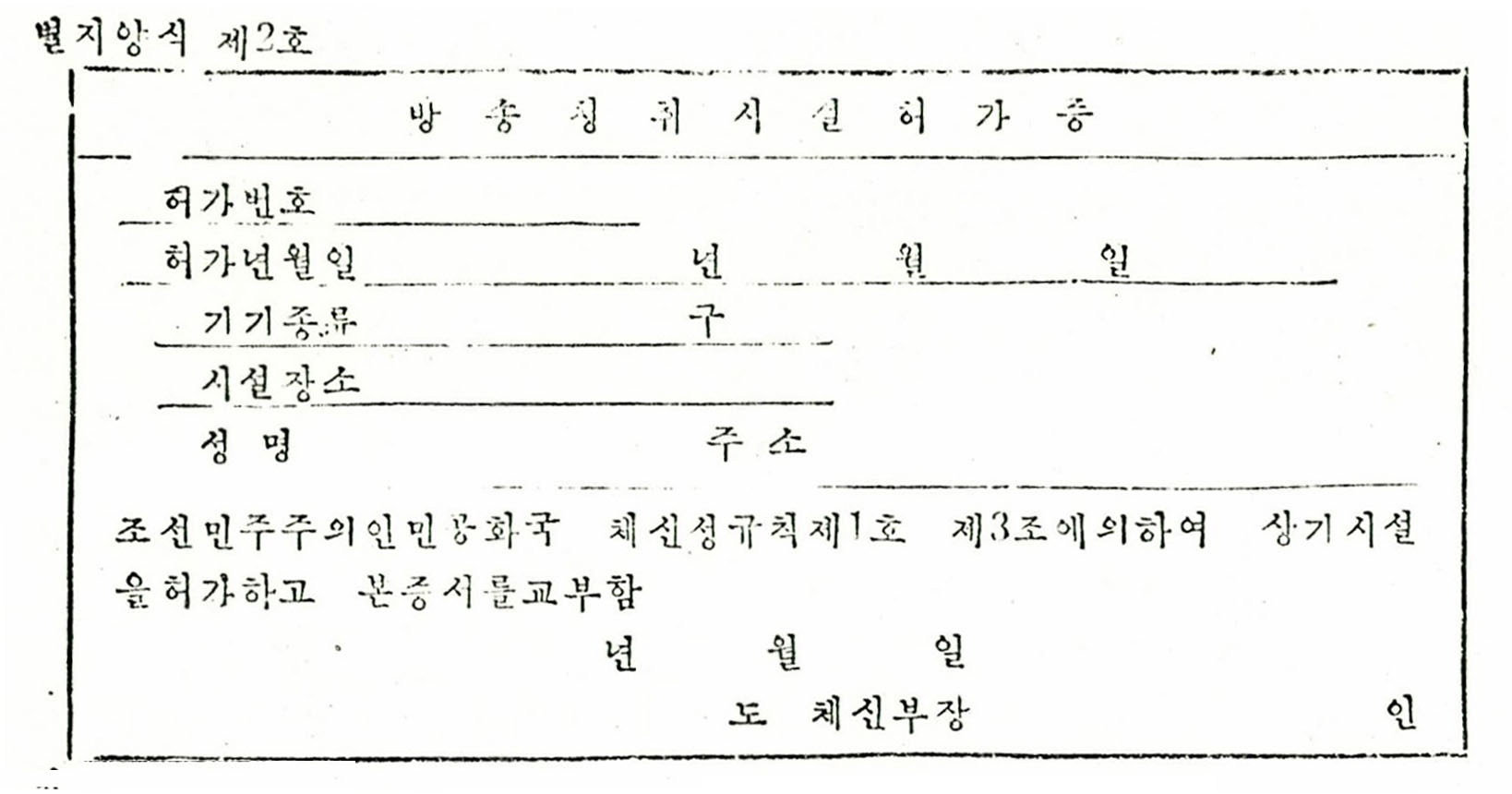
A copy of a radio listening permit issued in North Korea in the early 1950s. | Image: National Institute of Korean History.
Kim Il-sung’s government in early 1950 passed the first controls on how radios could be used by the North Korean population. Kim ratified ‘Ministry of Posts and Telecommunications Rule No. 1’, which required citizens to submit an application to own a radio in their homes, with a fee, to a post office.[7] The necessary permit was then, according to law, supposed to be issued within 15 days, or upon payment of the required fee for typically shorter-range medium-wave receivers. Ownership and usage was tightly monitored: if someone inherited a radio, they then had to flag this and the name change in relation to the device within 10 days. In the event of unreported radios, the owner would be fined three times the license fee, and post offices were charged with inspecting devices.
Article 14. of the law stated:
If a broadcast listening device installation facility operator issued by the competent conductor violates these regulations or commits an anti-state act, the facility permit may be revoked.
Thereafter, North Korea steadily increased restrictions around radio broadcasting and usage, culminating in the Orwellian measures witnessed in recent years whereby sets could be turned down, but not off, in parts of the country including Pyongyang.[8] This NARA file captures a key moment in the evolution of North Korean radio towards greater restrictions, and a rare moment when North Korean news media silenced its leader.
[1] “Decisions of the Standing Committee, North Korean Labor Party Central Inspection Committee, issued 29 Oct 47, regarding the broadcasting system,” 201212, Item 9, Box 42, RG 242, National Archives and Records Administration.
[2] Andrei Lankov, “Kim Takes Control: The ‘Great Purge’ in North Korea, 1956-1960,” Korean Studies, Vol. 26, No. 1 (2002), p. 97.
[3] Lee Chong-sik, and Oh Ki-wan, “The Russian Faction in North Korea,” Asian Survey, Vol. 8., No. 4 (April 1968), p. 278.
[4] Kim, Eung-gyo. Social Imagination and Korean Poetry (사회적 상상력과 한국시) (Seoul: Somyung Publishing, 2002), p. 196.
[5] See “Press and Publishing,” August 2024, North Korean Information Center, National Library of Korea, Ministry of Unification. https://nkinfo.unikorea.go.kr/nkp/pge/view.do;jsessionid=rD_KucRxvP4cCe6-npJH7WWu1HxYdRy45pGmC-Ai.ins22?menuId=CL413 [accessed online 21 January 2026].
[6] Shtykov, Terentii F. Diary, 1946–1948, entry for 1 November 1946 (“Voprosy k Romanenko po vyboram” [Questions to Romanenko concerning the elections]), unpublished personal diary of the Soviet Civil Administration in North Korea, Russian State Archive of Social and Political History (RGASPI), p. 26.
[7] “Regulations on Listening to Radio Broadcasts,” Cabinet Gazette No. 2, January 1950, North Korean Gazette, National Institute of Korean History. https://db.history.go.kr/contemp/gb/level.do?levelId=nkgb_1950_01_31_a0002_00040 [accessed online 21 January 2026].
[8] See, for example: Daniel Gordon (dir.). A State of Mind [Film]. VeryMuchSo Productions / Kino International (2004).