Reading Rodong Sinmun, in South Korea
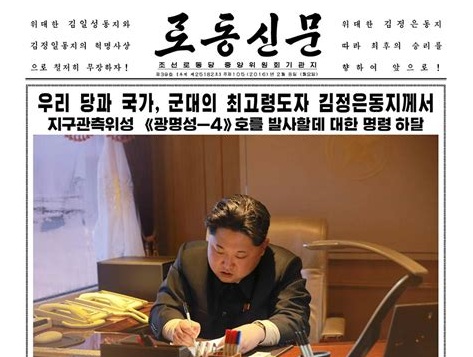
North Korean leader Kim Jong-un as shown on the front page of Rodong Sinmun. | Image: Wikicommons.
North Korea’s flagship Party newspaper may not yet be on sale at general newsstands in the South, but new reforms by President Lee Jae-myung mean the Rodong Sinmun has been reclassified from “special material” to “general material”.
This decision means South Koreans may now freely access the newspaper in 20 institutions across South Korea without submitting personal information and a clear reason for access in advance, as previously required by laws with their roots in the national security outlook of the late 1940s. Library message boards point to the frustrations experienced by South Koreans trying to access Rodong Sinmun in recent years.
This policy change occurred in late December. The process by which it was formulated and implemented points to the determination of the new Lee administration to engage the North, and the significant control the National Intelligence Service (NIS), South Korea’s CIA, has maintained over the dissemination of North Korean literature for decades.
In its Work Report for 2026, South Korea’s Unification Ministry on 19 December published detailed plans to “make 2026 the first year of peaceful coexistence on the Korean Peninsula”. New measures were aimed at resuming US-DPRK dialogue, building peace in border areas, and ending seven years of severed inter-Korean relations.
Buried at the bottom of the report, the ministry stated: “We will promote the opening of North Korean websites and the establishment of a legal foundation for the expansion of disclosure of North Korean materials, including the Rodong Sinmun.”
During a meeting announcing its North Korea policy led by Lee, the president said “assuming that people would be easily swayed by such material is, in itself, an underestimation of the public”. Lee described the continuation of controls on North Korean literature archaic and in need of reform. For all of its economic development since the 1960s, ROK executive confidence in the public’s ability to withstand ideological offensives from the North – such as they are – have rarely been expressed.
On 26 December, the Unification Ministry confirmed it was discussing “ways to make North Korean materials more accessible to the public” with relevant state agencies, having the same day held talks with the NIS on the matter. This promptly led to a relaxation of the rules from 30 December, the first time South Koreans have been permitted to read the Rodong Sinmun without prior approval since the Korean War.
It was not until the late 1980s that ordinary South Koreans were able to read the newspaper at all. The period marked South Korea’s move towards competitive democracy as it hosted the Seoul Summer Olympics in 1988. In Moscow, Mikhail Gorbachev had taken steps towards greater openness in the Eastern bloc with the announcement of his Glasnost policy in 1986 – but with no discernible impact north of the DMZ.[1] In North Korea, newspapers from the South remain illegal under the ‘Rejection of Reactionary Ideology and Culture Act’, passed in 2020 and amended in 2022, with severe prison terms for those caught with news media from the ROK.
After South Korean President Roh Tae-woo issued the 7 July Declaration for “National Self-Esteem, Unification and Prosperity” in 1988, less than a year later South Korea opened the Ministry of Unification’s Information Center on North Korea in Seoul.[2] Previously, North Korean materials including the Rodong Sinmun had been closely guarded within state agencies, notably in offices of the South Korean intelligence services meaning public access was all but blocked.
Even after the new reforms in 1989, ‘Guidelines for Handling Subversive Materials’ created numerous hurdles for ordinary South Koreans to access what were at the time were rare and previously unseen copies of North Korean newspapers.[3]
Under South Korean President Kim Dae-jung, South Korea after 1998 began to further relax restrictions on North Korean literature as his ‘Sunshine Policy’ led to the historic meeting with then North Korean leader Kim Jong-il in Pyongyang in 2000.
In 2009, the Unification Ministry moved the Information Center on North Korea (ICNK) to the National Library of Korea, maintaining access restriction to special materials including the Rodong Sinmun. As anyone who has visited the ICNK will be aware, restrictions have remained archaic.
In late 2025, the center still required visitors to complete registration by submitting personal details, a signed letter of sponsorship from an institution, details of the purpose of intended research, as well as contact information. Once inside, readers are then able to access decades of back copies of the Rodong Sinmun, as well as a host of other North Korean journals, magazines and books dating back to the 1940s.
A flick through early copies of the Rodong Sinmun reveals the extent to which South Korean restrictions appear to be overkill given the innocuous nature of much of the material, particularly older copies of the newspaper and articles on North Korea’s communist allies, including China.
For instance, the 9 July, 1952 edition of the Rodong Sinmun features on page 3 an article which describes Chairman Mao as having “a beautiful forehead like a philosopher”.[4] In an era when North Korea remained locked in conflict with the South, and the People’s Liberation Army ran military affairs in North Korea, the Party press in Pyongyang had become overly fawning to the Chinese leadership.
Although President Lee’s new measures have led to easier access to the Rodong Sinmun, there exist efforts in South Korea’s parliament to codify different classifications of North Korean literature which could further alter how the country’s citizens access printed material from across the DMZ.
In November, lawmaker Kim Ki-woong of the main opposition, conservative People Power Party introduced a bill which seeks to enshrine access according to clearly defined laws rather than guidelines drawn up by state agencies. The stated purpose of the proposed act is stated as:
To establish a management and utilization system for North Korean materials by directly regulating the collection, management, and use of North Korean materials in law, thereby contributing to the restoration of national homogeneity and the expansion of North Korean studies through a correct understanding of North Korea.
The bill proposes continued handling of North Korean materials under separate “special” and “general” classifications, and would require the Ministry of Unification to establish clear standards on handling DPRK literature by establishing a new ‘North Korean Materials Review Committee’.
After passing through the National Assembly Intelligence Committee, a process which can include closed briefings with NIS, the proposed legislation reached the 2nd National Assembly Sub-committee, which often handles DPRK issues, on 25 November. Changes to the bill, and whether it will pass, should become clearer in the coming months.
For now, South Koreans are able to read the Rodong Sinmun as freely as ever, with further reforms on accessing North Korean literature expected as the Lee administration seeks greater engagement with – and understanding of – its northern neighbour.
[1] Leif-Eric Easley, “North Korean Identity as a Challenge to East Asia’s Regional Order,” Journal of East Asian Studies 17, no. 1 (2017): 37–63; and Bradley K. Pateman, “North Korea: The Last Remaining Bastion of Anti-Revisionism,” Asian Survey 63, no. 3 (2023): 455–478.
[2] Song Sung-Seob, “A study on Building a Cooperation Model for the Public Availability of Materials and Information on North Korea,” Information Management Research (정보관리연구), Vo. 41, No. 2 (2010), pp. 71-93.
[3] Ibid.
[4] Hong U-man. “모택동 주석과 함께 (1)” [Together with Chairman Mao Zedong (1)]. Rodong Sinmun, 9 July, 1952, 3.