Affective Ties: A Review Of ‘Cold War Comrades’ by Gregg Brazinsky
Brazinsky, Gregg. Cold War Comrades: An Emotional History of the Sino-North Korean Alliance. Cambridge University Press, 2026. 266 pp. ISBN 9781009633277.
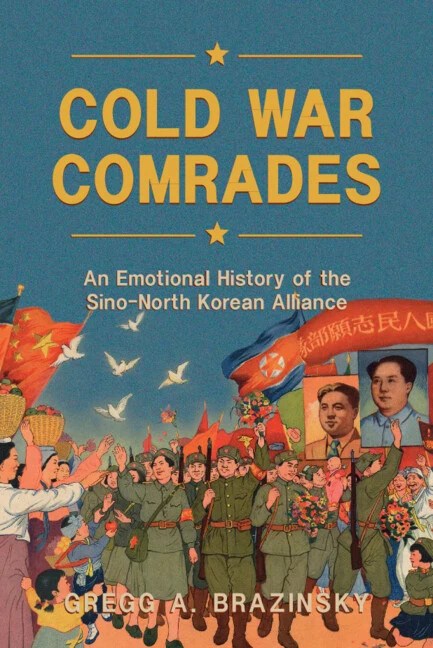
Cover image: Cambridge University Press, 2026
Most accounts of the Sino-North Korean relationship treat the language of friendship as a smokescreen. Leaders say “close as lips and teeth” (순치 脣齒) while quarreling over strategy and succession behind the scenes. The Chinese scholar Shen Zhihua, in an article in the New York Times in 2017, called this supposedly unbreakable friendship a “myth”. The author of Cold War Comrades, Gregg A. Brazinsky, professor of History and International Affairs at The George Washington University, does not dispute these quarrels, noting that they are “indispensable for communist state building in China and North Korea” (p. 4). By representing each other with sympathy and compassion, the two regimes taught their subjects how to feel and help build a sense of communist subjectivity, according to the author (p. 5).
Brazinsky therefore asks a different question: if the myth was so thin, why did two regimes spend seven decades working so hard to maintain it? The answer is that friendship was never just diplomatic, it was a lever by which to consolidate rule in each respective state. By teaching Chinese and North Koreans how to feel about each other, the Chinese Communist Party (CCP) and the Korean Workers Party (KWP) taught their own populations how to be loyal socialist subjects. The author concludes that neither the durability of the alliance nor the consolidation of the two states can be understood without this emotional regimen (p. 18).
The book is thus centered around the idea of emotions as an instrument of state-building. The author argues that the Sino-North Korean alliance remains one of the most intensive such examples in modern history. Idioms like 同甘共苦 (tóng gān gòng kǔ), “same joys, common pain” were not decoration but instructions. The book’s neatest insight is that empathy toward the foreign ally reinforced national identity at home. When Chinese citizens wept for North Korean suffering during the Korean War, they reaffirmed their own revolutionary self-image; and North Koreans mourning Chinese volunteers were reminded of their own victimhood and struggle for independence. Internationalism, paradoxically, manufactured nationalism and party loyalty.
Another somewhat paradoxical idea about feelings noted by the author is that instrumentality and sincerity can coexist. The author argues that leaders were often moved by the feelings they cultivated, that performing required emotions which could in turn strengthen a performance and spur yet more emotions, and that Mao and Kim could be bitter rivals one year and genuinely sentimental the next. In the chapter “End of an Era”, the author offers vivid evidence: In April 1975, an ailing Mao greeted Kim Il-sung with the words “because you wanted to come, I came back to meet you,” and declined to discuss politics at all. The visit was staged as a spectacle, yet it also appears as a genuine farewell between two aging revolutionaries.
If any section of the book deserves wider attention, it is the account of the North Korean film The Flower Girl (꽃 파는 처녀). Released in China in the 1972, the film had an estimated audience in Beijing of more than six million alone. Chinese viewers recalled uncontrollable weeping and rage at the film’s landlord villain (p. 214). The book recounts how one viewer, Luo Haibo, standing to fight the villain during one showing, and another Tie Ning crying so hard he struck his back on his seat (p. 215). This vivid chapter also describes a tour of China by the Mansudae Art Troupe in 1973, heavily staged welcomes parties, and North Korean performers calling elderly Shanghai women “Mama”, demonstrating how spontaneous cultural phenomena were harnessed and guided by both states. These are striking case studies which examine the line between authentic and orchestrated feelings, and would appeal to readers of film, media, and cultural studies as much as those focused on political history.
During more recent decades, the author argues that the China-DPRK friendship did not merely fade, but was rather recycled. After the Cultural Revolution, recollecting a shared past helped legitimise the political transitions and related turmoil of the 1970s and 1980s, including China’s reform era and the move toward hereditary succession in North Korea (p. 220). China’s normalisation of relations with South Korea in 1992 was then a key turning point for China-North Korea relations. It was marked by one of the book’s most striking scenes: Chinese Foreign Minister Qian Qichen arrives in Pyongyang to break the news to a nearly silent Kim, with no crowds, no banquet, and the “shortest” meeting Kim ever held with a Chinese delegation (p. 234). Yet the conclusion argues that this friendship has survived based on what the American historian Barbara Rosenwein calls an “emotional inheritance,” which is always available for leaders to draw on strategically (p. 241).
The approach and methodology of this book makes it unique. The history of emotions is a growing field, but it is rarely applied to Cold War diplomacy, where realist and strategic analysis dominates. The book argues that Cold War alliances in general, including American ones, were held together by more than mere strategic interests. The author notes that Christina Klein’s work on American cultural interactions with Asia during the Cold War demonstrates US culture cultivating sentimental attachment to Pacific allies. Brazinsky also stresses a key difference in that American officials did not impose emotional norms or punish those who lacked the right feelings (p. 240). On the other hand, the evidence for what ordinary North Koreans felt is thin, as the author concedes (p.246). Indeed, the feelings of North Korean citizens remain a near complete blackbox as there are few fora in the DPRK that allow free expression on international issues. We do, however, have a somewhat better understanding of how the North Korean state represents China and their shared historical relationship.
The book’s argument is timely. Commentators routinely predict that Beijing will “abandon” or “rein in” North Korea, and the author’s verdict is that those who expect a dramatic shift will be disappointed, since the ideals of friendship are “deeply imprinted in the DNA of both states” (p. 249). The relationship cannot be read through strategy alone. Escalating Sino-American rivalry, Chinese President Xi Jinping’s revival of Maoist-style ideology and personality politics, and the continued prestige of the Korean War in the People’s Liberation Army, and among neo-Maoist elements, all suggest the emotional inheritance shared in both states is again being reactivated. It is certainly an eye-opening angle for those who view international alliances as purely transactional.
Cold War Comrades is a thoughtful, well-evidenced book that poses a new set of questions. Rather than asking whether the friendship was real, it asks what the friendship did, and the answer illuminates not only two regimes but the broader politics of feeling. Scholars of the Cold War, East Asia, and the history of emotions will find a rigorous, original argument, while policy analysts and journalists covering North Korea and China will gain a framework for why rhetoric of friendship reappears following every apparent crisis.