Beyond CRINK: Southeast Asia in North Korea’s New Diplomacy
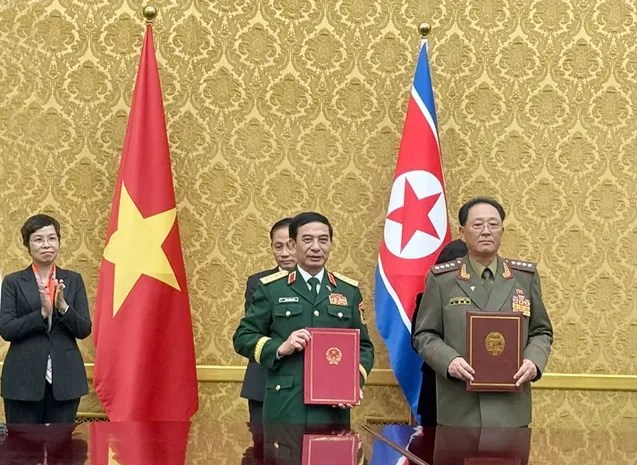
Vietnam and the DPRK sign a ‘Letter of Intent on Defense’ in Pyongyang in October. | Image: Hanoi Times.
Geopolitical analysts are more interested than ever in connectivity between North Korea, Russia and China, with some going further to include Iran in a “quartet of chaos”, or informally, CRINK. Celebrations around the 80th anniversary of the Korean Workers Party (KWP) last month represented a convergence of sorts, with China and Russia both dispatching their respective second-in-command leaders to Pyongyang – Premier Li Qiang and Unity Party head Dimitry Medvedev. Amid the rubbing of shoulders in the North Korean capital, the presence of two leaders of smaller authoritarian, communist states received far less attention.
This article will discuss the visit to North Korea of Communist Party of Vietnam (CPV) General Secretary To Lam, and the head of the ruling Laotian People’s Revolutionary Party (LPRP), President Thongloun Sisoulith. The presence of To Lam and Sisoulith offers a further tangible indication that the DPRK has accelerated its global diplomacy following Covid-19. The inclusion of the most senior ruling party figures from Vietnam and Laos also demonstrates that understanding North Korea’s recent upsurge in high-level political interactions requires analysis that stretches beyond the boundaries of the now well-worn moniker CRINK – China, Russia, Iran and North Korea.
To Lam’s Pyongyang trip suggests the progression of ties between North Korea and Vietnam, based on recent precedent. Most famously, North Korean leader Kim Jong-un met his Vietnamese counterpart Nguyen Phu Trong in Hanoi in the wake of the failed DPRK-US Summit in the Spring of 2019. Yet this past October 2025 marked the first time in 18 years North Korea had received the top Party official from Hanoi, following the visit of Nong Duc Manh in 2007, and was only the third such visit ever – Ho Chi Minh travelled to the North Korean capital in 1957.
When Pyongyang played host for the 70th anniversary of the WPK a decade ago, Vietnam sent the Secretary of the CPV Central Committee Ha Thi Khiet, a female, lower-level official just outside of its then 16-member, all-powerful Politburo. Taken in a longer-term view, To Lam’s appearance in Pyongyang marks an increase in high-level diplomacy between both sides that mirrors, but appears unrelated to, recent North Korean diplomacy with Russia and China.
This diplomatic upgrade was also evident last month with Laos, itself a long-time, close communist ally of Vietnam. The presence of LPRP head and President Sisoulith in Pyongyang in October contrasts sharply with a decade ago when Laos dispatched Chansy Phosikham, also secretary of the Central Committee of the ruling Party. President Sisoulith’s October visit marks the first time Laos has sent its president to North Korea in 14 years, and only the third time since 1992. This high-level exchange was immediately followed by a meeting between Laotian Foreign Minister Thongsavath Phomvihane and DPRK Foreign Minister Choe Son-hui in Pyongyang last week.
Laos politics observers will note that Thongsavath Phomvihane is the brother of Saysomphone Phomvihane, the man tipped to succeed Sisoulith as Party head, and soon after national president, when the ruling LPRP convenes for its 12th National Congress in early 2026. The Phomvihane brothers are in turn the sons of Kaysone Phomvihane, the first head of state of newly Communist Laos from 1975, and the country’s longest-serving, post-independence leader who served as head of the Party for 37 years until his death in 1992. Phomvihane senior visited Kim Il-sung in Pyongyang four times between 1965 and 1992, the heyday of Laos-DPRK diplomacy.

Saysomphone Phomvihane | Image: Lao News Agency.
In many ways, Laos’ cyclical, dynastic Communist politics represents the closest match to the direct lineage, monarchic model still employed in the DPRK. Sons tend to follow their fathers into top jobs, typically many years later (current Prime Minister Sonexay Siphandone is the son of recently deceased former Party head and President Khamtai Siphandone). Will the return of a Phomvihane to the head of the Laos ruling Party further invigorate bilateral ties with North Korea?
Vietnam and Laos are old revolutionary comrades, but other states in southeast Asia with less historical connectivity are also making closer ties with North Korea. Indonesia sent its Foreign Minister Retno Marsudi Sugiono to Pyongyang in October, the first such visit to the DPRK in 12 years, following the reopening of its embassy in the North Korean capital in July, post-Covid-19, under new Ambassador, Gina Yoginda, a former military major-general. Indonesia is one of only three ASEAN countries which currently operate functioning embassies in Pyongyang, along with Vietnam and Laos. Again, there was no Indonesian delegate when the WPK marked its 70th anniversary in Pyongyang a decade ago.
Iran remains oft cited in regards to North Korea but, at least officially, there remains little in the way of high-level exchange between Tehran and Pyongyang. Iran sent Mohammad Ali Amani, General Secretary of the conservative Islamic Coalition Party to Pyongyang last month, whereas a decade ago for the 70th WPK anniversary there was no public record of any Iranian presence in North Korea, just a congratulatory message. In the summer 2025 Israeli and American attacks on Iran’s nuclear facilities, the absence of any discussion of North Korean contributions – real or imagined – to those technical achievements was itself telling. North Korea’s condemnation of the attacks received little attention, and, several months later Mark Fitzpatrick at IISS engaged in what he called a “highly speculative” scenario considering whether Iran might look to North Korea as a possible source for nuclear kit. But measured by official visits and delegations, Southeast Asian states are doing more than Iran to maintain ties to DPRK.
These remain the only high-level Party and governmental exchanges between North Korea and the rest of the world since the Covid-19 pandemic, besides those of China, Russia, and its staunch ally Belarus, as covered by Sino-NK.
Put together, this suggests North Korea has broadened its diplomatic efforts beyond CRINK, with a particular focus on Southeast Asia. Recent diplomacy dynamics also tell us Pyongyang has expanded its reach beyond authoritarian regimes since, although ruled by a former military official in President Prabowo Subianto, Indonesia is the only current, high-level political partner of Pyongyang which holds meaningful elections (and is, by extension, ranked outside of the ‘not free’ category by Freedom House).
Why Now?
Following the end of Covid-19, North Korea began to cautiously re-engage diplomatically in 2023, when Beijing sent a new ambassador to Pyongyang in March of that year, and in September Kim travelled to the Russian Far East to meet President Vladimir Putin. Certainly, Russia appears to be the catalyst for North Korea’s recent relative surge in diplomacy, leading as it did to a security pact and the deployment of troops to Ukraine in 2024. More recent diplomatic activity in relation to Belarus appears to be an extension of Pyongyang’s Russian gambit, helping to further sure up ties with Moscow, as noted previously by Sino-NK.
North Korea’s recent high diplomacy activity therefore comes from a low, or non-existent base directly after its closure to Covid-19 in early 2019 into 2023, and has been driven in part by its military deployment to the Ukraine conflict.
Recent diplomatic engagement with Indonesia, although less substantial, remains little understood, but likely stems from the recent reopening of Indonesia’s Pyongyang embassy and efforts on both sides to reignite a longstanding relationship dating back 50 years. Indonesia was a founder of the Non-Aligned Movement in the early 1960s, which in turn was embraced by North Korea in the 1970s as a means through which to curate its then new efforts on the international stage beyond the USSR and China amid the Cold War.
Suggestions in South Korean media that Indonesia may be susceptible to offering fighter jet trade secrets to the DPRK in relation to their joint KF-21 project seem somewhat far-fetched, and are unlikely to be related to recent Jakarta-Pyongyang diplomacy. Although Indonesia has reneged on payments to South Korea for this military project, and its technicians were caught trying to remove data from a related facility in South Korea using a flash drive, the possibility Indonesia might give South Korean military technology to North Korea seems less likely in reality, and more so on screen. No evidence of plans to pass the information to the DPRK were known to have been detected during substantive investigations in South Korea, and Indonesia has no previous record on trading military secrets between geopolitical foes.
Beyond Byungjin
With Vietnam and Laos, there are signs the DPRK hopes to further engage likeminded Communist states with similar development trajectories. Like the Korean Peninsula, Vietnam was once split along ideological lines, sanctioned by the US for decades (until 1994), and underwent a period of economic reforms known as Doi Moi. There are few other countries with as similar a political and economic trajectory to that of the DPRK (as noted by Nguyen Thi Tham and Ha Anh Tuan in their analysis of relations between the two countries published earlier this year).[i]
In terms of political rights and civil liberties, Vietnam scores considerably better than China, Russia, Belarus, Iran and Laos, according to Freedom House. From the view of Policy-makers in Washington DC, Vietnam is also considered far less rogue: the country is non-nuclear, opposed to Chinese expansion in the South China Sea, and harbours no designs on its territorial advances (save some alleged tinkering with border posts on its western frontier with Cambodia). Therefore, from a Western political rights and security perspective, Vietnam is considered a far more palatable partner for the DPRK than the remainder of the supposed CRINK alliance.
Recent high-level exchanges between Hanoi and Pyongyang point to the possibility of more substance to this relationship, as both sides signed a “Letter of Intent on Defence Cooperation”, and a memorandum of understanding between their respective chambers of commerce. Although a quasi-state run body, the Vietnam Chamber of Commerce and Industry and its membership includes thousands of companies, many privately run, which could serve as a model for North Korean economic reforms.
Indeed, interacting with countries like Vietnam and Laos represents a key test of Kim’s Byungjin, or dual track military-economy policy first announced in 2013 and modified five years later – at least in its overseas trade and investment setting. A key reason why previous North Korean efforts to solidify international partnerships with lesser, more equal partners like Vietnam and Laos have failed is in part because these ties constituted little of substance outside of Party platitudes and expressions of interest. In short, North Korea had little to offer in terms of trade and investment: Although Vietnam ranks among North Korea’s top five trade partners, vice versa the DPRK is little more than a statistical footnote to Vietnam’s booming economy, while South Korea is now Vietnam’s fourth-largest foreign investor.
If North Korea is to extend its global reach and long-term diplomatic engagements, it would need to forge partnerships which extend beyond secretive and too often fleeting defence deals, and broker expanding trade and investment relationships – with countries like Vietnam and Laos.
[i] Nguyen Thi Tham and Ha Anh Tuan. “The Vietnam–DPRK Experience: Sharing and Engagement for Peace and Prosperity.” In Engaging North Korea, edited by Lam Peng Er, 206-225. London & New York: Routledge, Taylor & Francis, 2025.