Sea Change: the DPRK, and Russia’s New Maritime Power
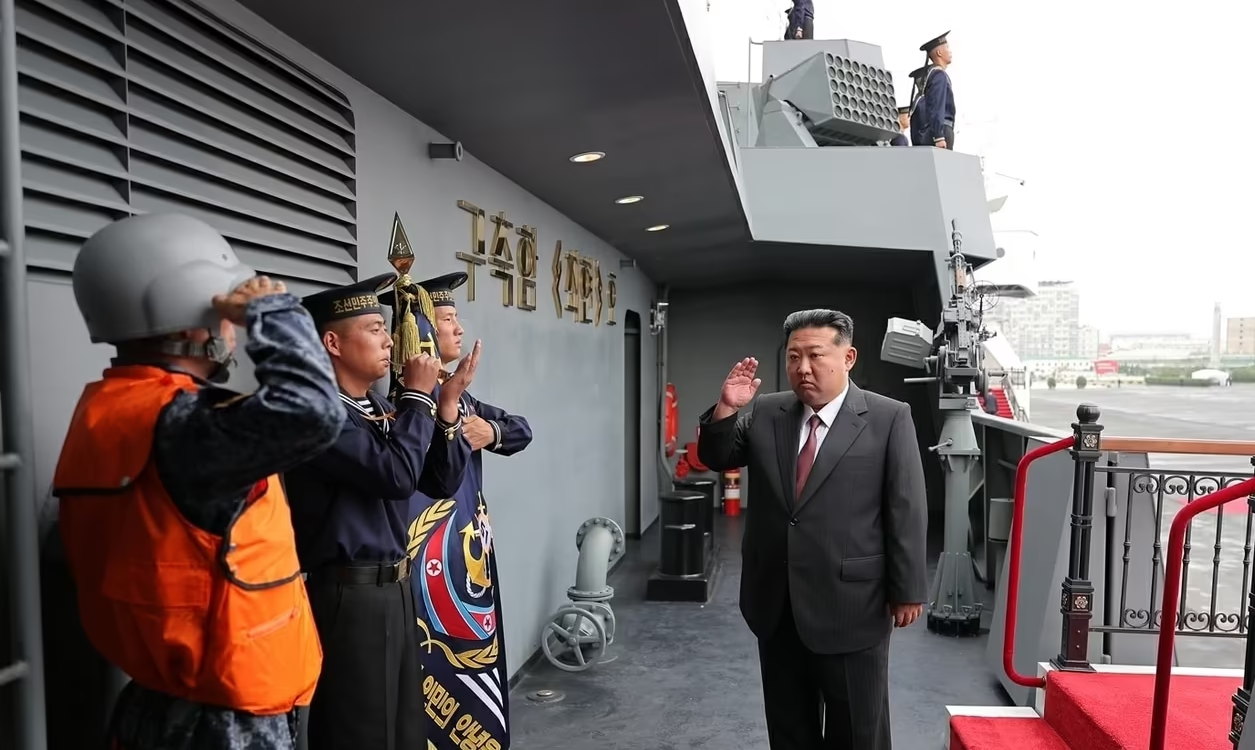
North Korean leader Kim Jong-un inspects a Choe Hyon destroyer at an undisclosed location presumed to be Nampo in early October. | Image: Rodong Sinmun.
Emperor Alexander III’s proclamation in the early 1880s that the Russian army and navy represent the country’s sole allies holds only partially true today given North Korea’s status as a major defence partner for Moscow. Yet if the DPRK has indeed become a true Russian ally in addition to its land forces and sea fleet, it is surely the latter which most clearly underscores the strength of the Moscow-Pyongyang security partnership, despite the Korean People’s Army’s ongoing contributions to Moscow’s war efforts in central Eurasia.
Growing attention on Russia’s agency in regards to the Korean Peninsula following the 2024 DPRK-Russia mutual defence treaty has led to expanded consideration of its potential role as a maritime actor. This necessitates a shift in analysis from what has been a predominate focus on Russia’s capacity as a Eurasian power, at best operating on the fringes of East Asia, to that which considers its role as a maritime actor in relation to the Northeast Asia sub-region, and what US policymakers regard as a primarily maritime domain – the Indo-Pacific.
The Korean Peninsula as Russia’s Pacific Weak Link
Barry Buzan and Ole Wæver, the creators of Regional Security Complex Theory, argue that part of what makes a regional security sector is shared perceptions of threats that travel over specific, limited geographical distances. For this reason, Northeast Asia and the so-called post-Soviet space have traditionally been regarded as separate.
Nevertheless, recognition of the Korean Peninsula’s role in the Russian Federation’s strategic interests has been growing among Korea analysts. One aspect that makes the peninsula unique is its place in Russia’s strategic maritime considerations.
The Russian Federation’s quest for strategic depth around its periphery has traditionally meant that Moscow seeks to project influence primarily on the areas of Eurasia (as a strictly geographic conception) on its immediate continental periphery – Eastern Europe, Central Asia and the Caucasus, as well as its borders with China and Mongolia. Yet this does not mean the Korean Peninsula has no role in Russia’s quest for strategic depth. Indeed, Moscow has shown growing interest in using the Korean Peninsula to enhance its strategic depth in East Asia.
Simultaneously, the Korea Peninsula stands out in terms of the degree to which it comprises Russia’s primary maritime strategic weak point. As Kim Sung-bae of the Institute for National Security and Strategy in Seoul has asserted, because the Korean Peninsula is part of the ‘Rimlands of Eurasia’, Moscow’s interest in revising the security landscape on its Pacific borders is in part what drives its relations with Pyongyang.[1] The ‘Rimlands of Eurasia’ are, in turn, a concept devised by the Dutch journalist and academic Nikolas Jan Spykman during WWII.
Placed in geographical context, the Korean Peninsula’s land border with Russia only runs for 17 kilometres. Yet the seas around the Korean Peninsula are adjacent to some of the most important maritime ports of the Russian Far East, including Nakhodka,[2] Vladivostok and Zarubino. As such, it is in the Kremlin’s interest to extend Russia’s strategic depth into the maritime realm, particularly in the interest of augmenting ties between the Russian Far East and the dynamic economies of the Asia-Pacific.
The potential for Russia to project naval power around the Korean Peninsula has gained increasing recognition from analysts and policy makers. According to the South Korean academic Choi Woo-seon, writing for the Institute for Foreign Affairs and National Security in Seoul, the Russian response to an armed contingency on the Korean Peninsula would more likely involve the Russian Navy’s Pacific Fleet than ground forces.[3] Likewise, General Xavier Brunson, commander of United States Forces Korea (USFK), recently noted the strategic value of the Korean Peninsula in limiting the Russian Pacific Fleet’s maneuverability.
The sum total of recent analyses means that, whereas discourse often centres on Russia as a land-based power projecting influence primarily in the continental Eurasian theater, the Korean Peninsula demonstrates Russia cannot be so easily compartmentalized as a continental actor. Rather, Russia’s ability to project influence on and around the Korean Peninsula is a case-in-point of the broader difficulties in compartmentalising security among regionally-based divisions. It also indicates a shift in military power in a strategic region of the Indo-Pacific which in recent decades had remained dominated by the US and China.
Balance of Maritime Power
At the heart of Russia’s maritime interests around the Korean Peninsula is the balance of power. In contrast to Russia’s centuries-old reliance on continental strategic depth, the Kremlin’s Far East maritime interests lie primarily in preventing itself from being boxed in from the Pacific. This is not unlike China’s desire to break through the First Island Chain – Japan, Taiwan, the Philippines and Borneo – and even the Second Island Chain in Guam, the Northern Marianas, and Palau.
Such concerns are hardly new for Moscow: Even during the Cold War, the U.S. had an interest in strategically containing the Soviet Navy in the Pacific. Today, however, the factors that influence balance of power considerations for Russia in Northeast Asia have evolved considerably.
In the immediate post-Cold War period, Moscow drew down its military forces in East Asia, paving the way for the China-US great power dyad in the region. Even so, the Russian Federation has not been without a voice, including in areas relevant to its ability to project naval power. Although not nearly as vociferous in its opposition as China, the Kremlin roundly condemned the US deployment of the Terminal High Altitude Area Defense (THAAD) system in South Korea in 2017. THAAD, which Russia criticised for upsetting the military balance of power in Northeast Asia, presents a host of challenges to its maritime power – even though THAAD is a land-based system, it is capable of intercepting ballistic missiles from the Russian Pacific Fleet, while its AN/TPY-2 radar can conduct surveillance of related activities. Amid all of this, the Kremlin has seen Japan begin to rearm, while South Korea continues to pursue its blue water navy ambitions whereby it would project increased maritime capabilities further afield in the Indo-Pacific.
In light of these shifts, cooperation with North Korea has become critical for Russia and its wider maritime security aims. This not only means having a friendly state adjacent to its Pacific periphery, but potentially a partner to help increase its maritime capacity. Although the timeline for full deployment remains unclear, the April launch of North Korea’n’s Choe Hyon class destroyer, whose equipment bears a striking resemblance to that used on Russian vessels, has raised speculation Moscow may have aided the DPRK directly in its new naval endeavour.
Russian Sea Power and the US-ROK Alliance
If anything, increased recognition of Russia’s potential role as a maritime actor near the Korean Peninsula is not a new concept but rather the recovery of an understanding of the Korean Peninsula’s strategic value, which was more prominent during the Cold War. With discussions underway as to how the US-ROK alliance can meet challenges beyond deterring the DPRK, policymakers cannot make an adjustment without considering Moscow’s renewed role. This surely means the Russian Federation is positioning to become a more formidable Indo-Pacific maritime actor in US and South Korean policy thinking.
The Korean Peninsula may be only one part of the Indo-Pacific, a primarily maritime realm as far as US strategic planning is concerned, yet it remains continental Russia’s primary geopolitical gateway to this security theatre. However much Washington shifts its focus toward the Indo-Pacific, the US is now likely to find it cannot escape the Kremlin’s agency in the Northeast Asian maritime region.
In this regard, the Korean Peninsula is set to stand out as a unique sub-region of the broader Indo-Pacific conception, one where the main continental power of the Eurasian landmass is becoming positioned to flex maritime muscle in addition to the US and China. This gives Korean Peninsula-focused strategic planners an extra task in what is an already complex security region.
[1] Kim Sung-bae (김성배), “An Analysis of the Geopolitical Implications of the Deployment of KPA Troops in the Russia-Ukraine War (북한군 러-우전쟁 파병의 지정학적 의미 분석),” Institute for National Security Strategy Issue Brief 622, p 4-5.
[2] Nakhodka, a port where Russia has reportedly been receiving arms shipments from North Korea, was designated as a site of interest for US intelligence in Section 205 of the 2017 ‘Countering America’s Adversaries Through Sanctions Act’ for potential DPRK-related sanctions violations.
[3] Choi Woo-seon (최우선), “DPRK-Russia Alliance and South Korea’s Policy (북·러 동맹과 한국의 정책),” Institute for Foreign Affairs and National Security, 2024, p 4.