Business as Usual: Liaoning Leads China-DPRK Trade Revival
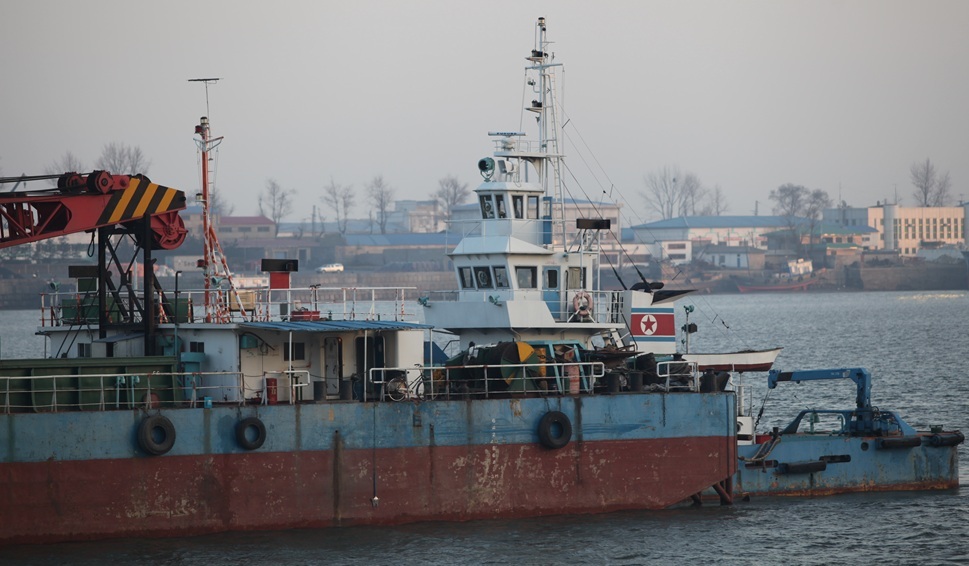
A North Korean commercial ship docked close to the Dandong side of the Yalu River prior to the Covid-19 pandemic. | Image: Sino-NK.
Much has been made of the rebound in China-DPRK trade this year. Volume is up 25.5 percent for the year up to the end of October, a statistic which arrives on the heels of the first meeting in six years between leaders Xi Jinping and Kim Jong-un in September. Yet there is an even greater surge in trade along the Chinese-DPRK border, and Liaoning province accounts for the bulk of this activity.
New Customs data shows trade growth between Liaoning and the DPRK has soared 75.5 percent thus far this year, increasing at three times the rate of overall China-DPRK trade. The province is set to register a record year for import-export activity with the DPRK. By the end of October, trade between this northeastern frontier province and neighbouring North Korea had reached RMB 8.15 billion (USD 1.15 billion), with Liaoning accounting for nearly 54 percent of China’s total volume with the DPRK which in turn reached RMB 15.2 billion over the same period. The vast majority of this volume remained Chinese exports to the DPRK, rather than vice versa, with China the dominant supplier of goods to its reclusive neighbour.
Dandong in Liaoning serves as the main overland gateway for Chinese and indeed global trade to North Korea, with limited cross-border commercial activity at nearby Kuandian-Ryongchon. The city of Dalian is the key maritime trade hub in the province along with Dandong and its adjacent port in Donggang, with subsidiary but significant roles being played by Yingkou, and Jinzhou. Yingkou is a major source of maritime trade to Nampo, the main port close to Pyongyang, while Dandong’s port mainly services small-ship trade to nearby Sinuiju.
In 2023, Liaoning set a record for its trade with neighbouring North Korea which reached RMB 8.34 billion, only to witness a major slump in 2024 as import-export activity fell back to pre-Covid-19 levels at just over RMB 6 billion. By contrast, 2025 is set to eclipse 2023 as the highest trade year on record between Liaoning and the DPRK when combined bilateral imports and exports reached a high of RMB 8.337 billion. With two months of trading data remaining in 2025, the DPRK and Liaoning are well on course to surpass this total.
Changing Trade Dynamics
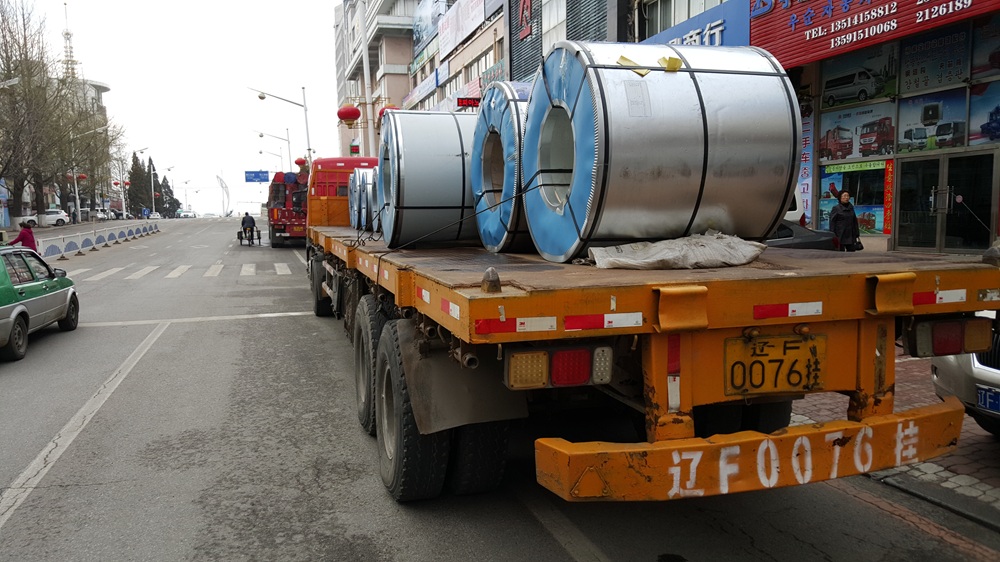
A Chinese truck shipping metal to North Korea waits outside the Dandong Customs House. | Image: Sino-NK.
A simple explanation for the sudden revival in China-DPRK trade this year might be found in high-level politics, with Kim Jong-un’s face-to-face meeting in Beijing with Xi in September. Kim’s delegation was though more political rather than economic or trade related, and included Foreign Minister Choe Son-hui, his sister and deputy director of the Propaganda and Agitation Department Kim Yo-jong along with department Director Ju Chang-il, Worker’s Party of Korea International Affairs Director Kim Song-nam, and Organisation and Guidance Department Head Jo Yong-won. The only economic-related official who travelled on the DPRK side was Kim Tok-hun, secretary of the Party Central Committee and chair of the budget committee, an internal economic role rather than an external trade position. Kim was quoted as saying, in official Chinese accounts, that “the DPRK will deepen mutually beneficial economic and trade cooperation with China for more fruitful outcomes”, the clearest indication from the meeting that trade was indeed on the agenda. The influence of politics on this unique bilateral trade relationship should not be underestimated, however.
Overall, trade data does not support the hypothesis that the Kim-Xi tete-a-tete served to significantly spur overall bilateral trade, at least not in the long-term and not thus far. Instead, Customs data indicates a small uptick in DPRK trade with Liaoning and China overall in September to coincide with the bilateral meet-up in Beijing, particularly in terms of DPRK exports to China which recorded 24.4-percent growth up to the end of August, jumped to 27.8 percent in September, and then fell back slightly to 26.2 percent in October. This indicates a positive blip in September rather than a sustained additional escalation in bilateral commercial activity. It remains to be seen what, if any, concrete agreements may have been made in Beijing, and whether these and the reconnecting of high-level political ties will further accelerate trade into 2026 and beyond.
This year’s jump in trade between the DPRK and China, notably with Liaoning province, can be better explained in that it comes from a relatively low base in 2024, the same year North Korea began to shift part of its economic reliance on China to Russia amid rapidly evolving political and security ties between Moscow and Pyongyang, as noted by the Korea Development Institute. As a result, the DPRK recorded declines in DPRK trade of 27.3 percent and 4.1 percent with Liaoning and the whole of China respectively in 2024.
Another key factor: the reopening of North Korea to business and some tourism following Covid-19. Sino-NK understands that, after years of border restrictions, North Korean businessmen were by this Summer much more visible in Dandong than at any time since the pandemic. This is a key indication the DPRK is sending trade representatives to do business with China since their presence had been very sparse between early 2020 up to the start of this year, and it is in Dandong that much of the trade relationship is forged and executed.
This comes off an improving domestic economic base inside the country: the DPRK recorded an estimated 3.1 percent GDP growth in 2023, which climbed to 3.7 percent last year, according to the Bank of Korea, representing the highest growth in eight years. North Koreans and their trading companies therefore appear to have more money to spend, are able to travel more easily to spend it, and likely have pent-up demand following the pandemic which is now translating into significantly increased consumption in the DPRK’s nearest overseas market, Liaoning province.
There are also growing indications sanctions enforcement and scrutiny is waning in relation to North Korea. Gone are the days of relatively strict enforcement by China in 2016 and 2017 when the DPRK completed its last two nuclear tests. At the end of April of this year, a veto by Russia caused the UN Panel of Experts to disband, meaning the body was no longer reporting and scrutinising DPRK sanctions enforcement by the rest of the world for the first time in 15 years. This was considered very good news for North Korean traders, and Chinese partners, in cities including Dandong and Shenyang.
Although the Korean Won has reportedly crashed in value this year, in theory making overseas purchases more expensive, this should be understood in terms of a symptom of stricter exchange controls enforced by Pyongyang combined with a greater demand for US dollars and Chinese yuan as businessmen have returned to China and elsewhere. So, although purchases in China have in theory become more expensive for North Koreans, there remain few other feasible options to source much-needed foreign goods. Russia-DPRK ties have improved significantly, but this is unlikely to translate into much improved border trade since their shared frontier is remote, and only 17 kilometers long.
Future Prospects
With no signs of a nuclear test by the DPRK in eight years, the end of UN scrutiny of sanctions violations, Moscow’s apparent new willingness to veto on behalf of Pyongyang, recent signs of warming ties between China and North Korea, and the latter’s apparent post-pandemic reopening this year, the prospects for bi-lateral trade remain strong.
Yesterday, the new CCP Secretary of Liaoning Province Xu Kunlin met with 20 local companies to exchange notes for the “comprehensive revitalisation of Liaoning”. This meeting points to positive prospects for Liaoning-DPRK economic partnerships since it included representatives of Dandong Dongfang Measurement and Control Technology Co Ltd, a company which has two decades of exchange history with DPRK technicians, and Ansteel Group Corp, reportedly a processor and re-exporter of North Korean iron ore.
Key challenges remain, however. In Dandong’s New District, the New Yalu River Bridge linking the city to Sinuiju is still closed with few signs of its imminent launch more than 14 years after work first began on the project. Although work has been detected this year on the new Customs houses on both side of the bridge, there have been few indications as to when this USD 350 million white elephant may finally open. When this does happen, bilateral trade between Liaoning and the DPRK will surely surge: the bridge features wide lanes on both sides for increased cargo traffic, and a trade zone adjacent to the Dandong side opened nearly a decade ago which was supposed to showcase North Korean goods.

The New Yalu River Bridge as viewed from the North Korean side in Sinuiju. | Image: Sino-NK.
Logistics continue to be a key problem for this trade relationship. Although the postal service across the Dandong-Sinuiju bridge recently resumed, Sino-NK understands that the daily train between Beijing and Pyongyang, which passes through Shenyang and Dandong, is now not due to resume until next year amid rumours in Dandong the service will restart after five years. This indicates trade routes between Liaoning and North Korea are set to improve further next year, but for the time being remain more limited than prior to the global pandemic.
Located adjacent to North Korea and yet hampered by enduring logistical issues, Liaoning continues to be the economic gateway to the DPRK, and a litmus test of bilateral relations between Beijing and Pyongyang. Booming trade along this key frontier therefore represents yet another recent sign China and North Korea may be improving ties, despite complications over the sudden injection of Russia into this already difficult relationship.