Divergent Foreign Policy on the Korean Peninsula, and ROK Security Priorities
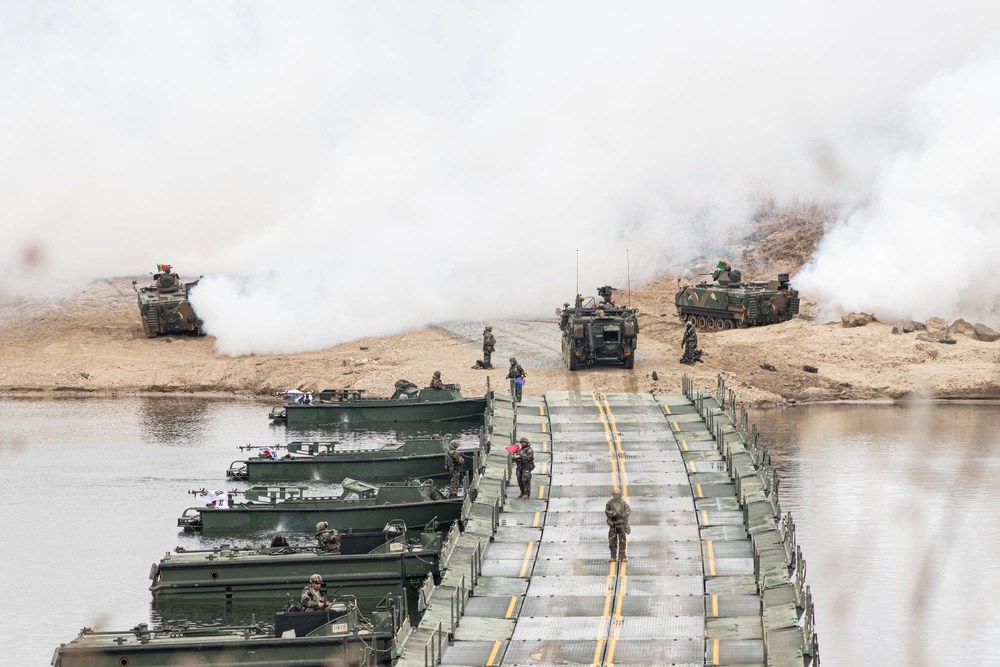
ROK and US Troops conduct ‘wet gap’ operations during Warrior Shield training exercises in South Korea in 2023. | Image: US Army photo by Spc Kim Gwang-neung, via DVIDS.
Following recent discussion of the DPRK’s place in Russian security in relation to Eurasia and Northeast Asia by Sino-NK, this analysis considers the evolving geopolitical concerns of the DPRK and South Korea as they have diverged from one another.
Consideration of South Korea as a missing link in the First Island Chain off China’s coast, a view developed by Congressional staffer and former Pentagon official Grace Kim in 2021, is as relevant a thesis as ever with the DPRK and ROK drifting further apart in their respective strategic orientations. South Korea, according to this line of thinking, operates as a de facto island, and as such has an integral role to play in US strategic imperatives, beyond deterring Pyongyang, in relation to China and the wider Indo-Pacific.
In Seoul, President Lee Jae-myung has expressed a desire to revitalise South Korea’s broadly-conceived ‘northern strategy’ of strengthening ties with the Russian Federation and other states on the Eurasian continent. South Korea is very much – if not a geographic component of the First Island Chain in the literal or even metaphorical sense – bound by the fate of geopolitical developments in this particular strategic conception.
Seoul cannot ignore threats posed by the new Moscow-Pyongyang axis which combines ‘Mackinder’s Heartland’, Eurasia and its dominant power Russia, with that of the DPRK on its ‘Rimlands’, as conceived by Dutch-American strategist Nicholas Spykman. Recent bilateral dynamics mean Pyongyang has taken a position of deeper orientation toward its original backer Moscow.
For its part, North Korea’s embrace of the “two state theory” (jeogdaejeog du guggaron, 적대적 두 국가론) suggests it has shelved immediate hopes of unifying the two Koreas with its embrace of a greater strategic orientation toward continental Eurasia. This includes not only North Korea’s own turn toward a greater focus on Eurasian continental security, but also its recent embrace of the Russian language – itself a key component of Moscow’s own Eurasian strategy – as a mandatory subject in schools. Not since the collapse of the Soviet Union and the end of the Cold War in the early 1990s has Russian been the primary foreign language studied in North Korea.
South Korea’s Strategic Importance in the First Island Chain
The View from Washington:
In the latter stages of the first Trump administration and the outset of the Biden government, Washington had a clear interest in bringing South Korea more deeply on board with US efforts to contain China, especially in the form of greater ROK participation in the Quadrilateral Security Dialogue, or ‘Quad’.
Under the second Trump administration, however, Washington seems to have taken a much different stance toward its alliance with Seoul, apparently placing less expectation that South Korea would align with broader US strategic objectives vis-a-vis China. A recent US-ROK ‘fact sheet’ following Trump’s meeting with South Korean President Lee at the White House in November, for example, mentions only a desire to maintain the status quo across the Taiwan Strait.
Even so, the US foreign policy community recognises across the board that the ROK’s strategic importance goes well beyond conventional deterrence of North Korea, extending into providing the US military with the ability to contain Chinese land, air and naval forces operating out of China’s Northern Theatre Command.
To be sure, Trump himself has frequently accused South Korea of free-riding on the US and its armed forces. Yet at the policy-making level, forces within both the US executive and legislative branches have been at work to ensure United States Forces Korea (USFK) more or less stays put.
US Under Secretary of Defence for Policy Elbridge Colby, Trump’s current lead on national defence strategy, has described USFK as having been “held hostage” in their focus on North Korea, and has argued that the ROK should take more responsibility for its own defence. Yet this does not automatically mean Colby supports the US president in the assumption that US troops in Korea aren’t serving a greater strategic purpose. Given there are ways to position US forces on the Korean Peninsula to deter North Korea and China at the same time, Colby himself has attempted to clarify that he does not support the US withdrawal from the peninsula, but rather an adjustment to allow the US military to respond to contingencies involving China.
Likewise, on Capitol Hill, US lawmakers have revived a dormant tradition of ensuring that the maintenance of USFK levels remains enshrined in law, barring tightly-defined circumstances. During the first Trump administration, the National Defence Authorization Act (NDAA) for fiscal years 2019, 2020, and 2021 contained provisions explicitly prohibiting the use of appropriated funds for the withdrawal of US troops from the ROK or Japan without prior consent. Such provisions were absent from annual NDAA’s under the Biden administration, although in the text of the NDAA for fiscal year 2025, Congress included three non-binding resolutions that affirm the US is commitment to defence of the ROK in the case of an outbreak of armed conflict.[1]
Likewise, the NDAA for fiscal year 2026 (which at the time of writing is undergoing the legislative process) contains legally-binding provisions affirming US commitment to defending South Korea. The text of the 2026 NDAA contains even more detailed stipulations regarding Washington’s commitment to ROK security than during Trump’s first term in the White House. Section 1322 of the version that recently passed in the US Senate prohibits the use of appropriated funding for the withdrawal of troops from the Korean Peninsula without prior consultation with relevant US allies, and also requires the Department of Defense to submit to Congress reports detailing impacts on both US and ROK security in the event of a US troop drawdown.
The 2026 NDAA’s successful passage would, among other things, enshrine the “sense of Congress” on the USFK into law for the coming fiscal year. Barring a major shift in the legislature’s composition in the coming years, lawmakers will conceivably continue working to ensure USFK troop levels are kept relatively unchanged, bearing in mind China and its perceived security threat.
Perspectives from Beijing:
The view that the Korean Peninsula is of strategic importance in great power rivalries past and present is hardly limited to Washington. In much the same way that the US recognises the Korean Peninsula’s strategic importance in relation to Beijing, China itself sees the Koreas as an integral part of great power competition with the United States.
One reflection of this is the revival of a Korean War-era rallying cry, “kang mei yuan chao (抗美援朝, resist America, aid Korea – the term China employed for its Korean War campaign)”, which is often used in conjunction with the phrase “protecting the home, defending the country (bao jia wei guo 保家衛國)” in Chinese discourse. Far from being limited to the blogosphere, the idea of the Korean War as being part of current Sino-US geopolitical competition has been used in recent years in public statements by Chinese military and diplomatic officials.
Indeed, as with other components of the First Island Chain, South Korea may eventually find its position vis-a-vis China similar to those of other US allies such as the Philippines amid ongoing South China Sea incursions. As Steve Yates of the Heritage Foundation recently warned, a failure on South Korea’s part to take adequate steps to counter Chinese naval activities in the Yellow Sea could lead to ROK commercial and military fleets dealing with harassment from the People’s Liberation Army Navy (PLAN) in its own backyard.
Such fears are particularly relevant for South Korea in the event of a contingency over Taiwan. According to ROK Navy Commander Jeong Neung, a Taiwan contingency could not only impact vital energy supply lines for the ROK, but could also see lead to increased maritime activity on the part of the PLAN and Chinese maritime militias.
South Korea’s Strategic Orientation: Pulled Between Land and Sea
As much as Lee Jae-myung may wish that future military confrontations between China and Taiwan would lie outside of Seoul’s concern, the reality is that the ROK faces certain choices: not only whether it would support the US in a Taiwan contingency, but perhaps more consequential, how much of its strategic priorities should lie in deterring the DPRK from taking an increasingly continent-facing security orientation in the maritime realm?
Complicating matters is the fact that the DPRK-Russia alliance, currently most active in Eurasian continental security, has brought the Russian Pacific Fleet more deeply into Korea’s strategic environment than at any point since the late Cold War period.
As such, the choice facing South Korea today is not the extent to which it aligns with the US over security policy, but rather whether it will embrace a more maritime-oriented security posture or focus primarily on preparing for contingencies stemming from a Eurasia-centred North Korea-Russia axis.
Washington, for its part, seems to be moving the US-ROK alliance more toward greater ROK integration with the First Island Chain amid its primary focus on China. Yet given that alliance managers cannot ignore the Russia factor, Seoul – and its alliance with Washington – will also need to maintain some level of readiness to deter what is now no longer a standalone North Korean threat, but a broader security challenge from the DPRK’s deeper orientation toward Russia. This, more than anything, will determine the extent to which the ROK truly is, for operational purposes, a de facto link in the First Island Chain.
[1] Sections of the 2025 NDAA that mention Korea include: Section 1311, on USFK force levels; Section 1344, on extended deterrence on the Korean Peninsula; and Section 1345, on security multilateralism with Indo-Pacific allies.