After Berlin: Assessing UK Foreign Office Talks on Korean Unification in the 1990s
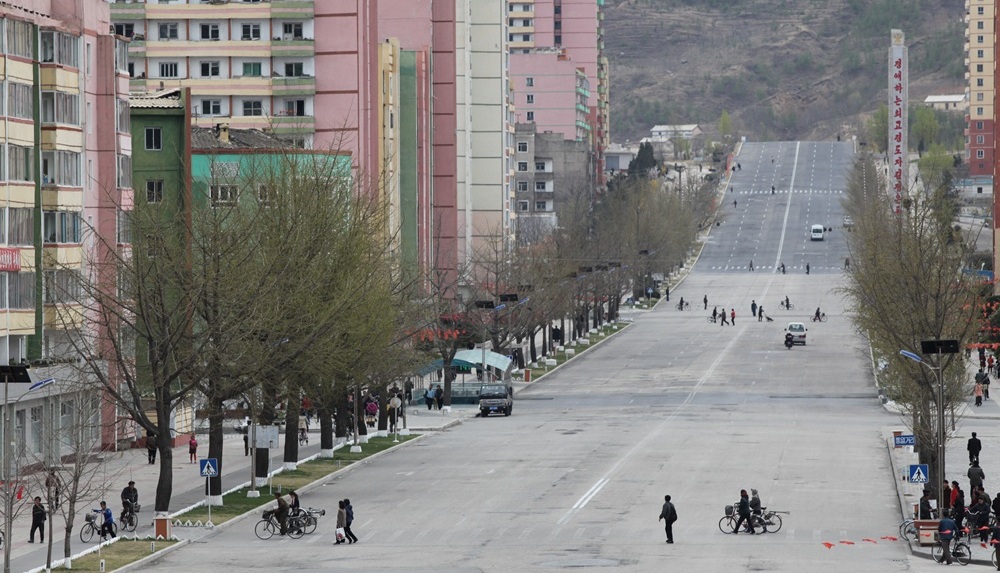
Modern-day Kaesong, part of North Korea and formerly under South Korean control between 1945 and 1950. Heading south from Pyongyang, Kaesong is the last major exit before the DMZ on the ‘Reunification Highway’. | Image: Sino-NK.
For many observers of international affairs in the early nineties, the fall of the Berlin Wall in November 1989 marked not only the beginning of the end of the division of Europe, but also a global realignment away from the ideological bipolarities of the Cold War and towards a new set of possibilities. Perhaps even a “new world order”, as phrased by US President George H W Bush in his State of the Union Address in early 1991.[1]
In the early years of this new world order, with the example of German reunification fresh in their minds, officials at the British Foreign and Commonwealth Office (FCO) in London began to consider the possibility of a similar reunion on the Korean peninsula. In accordance with the ‘thirty-year rule’ – the guideline that UK government materials should be made available to the public after approximately thirty years – the UK National Archives have recently begun receiving files from the early-to-mid nineties. One such file describes a seminar held by the FCO in May 1993 titled “The Challenge of Korean Reunification”, which invited contributions from a broad range of academics and government officials across the United Kingdom and the world.[2]
This event was the brainchild of Jim Hoare, later the first British chargé d’affaires in Pyongyang who played an instrumental role in the establishment of a British Embassy in North Korea in 2003, and was attended by representatives from the governments of France, Germany, the US, Japan, South Korea, Australia and New Zealand.[3]
The purpose of the seminar was to use this amalgamation of expertise to assess the prospects of Korean reunification in light of rapidly changing international conditions. The FCO, surprised as it was by the events in Berlin in 1989, perhaps sought to guard against the possibility of another unexpected reunion.[4]
Unsurprisingly, the representative from Seoul was given top billing, with Yang Chun-Park from the embassy in London presenting South Korean views on reunification. He was followed by two British academics, Paul Collins from the Royal Institute of Public Administration and Aidan Foster-Carter from the University of Leeds, who discussed the economic situation in the DPRK and North Korean views on reunification. Speakers from the Ministry of Defence and the FCO presented on military matters, discussing the balance of power on the Korean peninsula and the risk of nuclear proliferation, before Hoare and Robert O’Neill from Oxford University turned to the impact of reunification on the broader East Asian region, suggesting potential Russian, Chinese and Japanese reactions.
Conflicting Opinions

A page from the FCO digest on the meeting in May, 1993 described “general ignorance” in regards to North Korea, and the “most acrimonious discussion” among participants regarding North Korea and its continued viability as a state. | Image: Luke Thrumble.
According to an FCO digest circulated shortly after the seminar, the meeting, which “brought together virtually all this country’s experts on Korea both in and out of government”, was riven with disagreement. Participants were not only divided on the possibility of reunification and the means by which it might occur, but also in regards to the stability of the North Korean state. The “conventional wisdom” that North Korea was “on the point of economic collapse”, owing to the loss of Soviet aid and decades of Communist mismanagement, clashed with a “well-argued case” that the North Koreans had long since begun to manoeuvre their economy away from dependence on Moscow in the 1970s, and were entirely capable of adapting further in order to survive their tumultuous new circumstances.
The suggestion that reunification might result from North Korean collapse therefore provoked “the most acrimonious discussion of the day”. The discussion had two aspects: the first was the collision of two competing visions of the North Korean state – the conventional image of a hollowed-out, tin-pot dictatorship teetering on the edge of collapse, set against the contrary position that Kim Il-sung instead presided over a “comparatively prosperous, resource rich” nation which was “capable of adaptation”; and the second focused on whether reunification could only be achieved in the event of a collapse of North Korean authority mirroring that of East Germany. Ultimately, by show of hands, the notion that “reunification would largely be on the south’s terms” was widely supported, and a majority of the participants predicted a coming North Korean collapse, albeit with a sizeable minority maintaining their belief that the regime would survive.
The possibility that the North Korean regime could survive in the post-Cold War era raised the question of whether reunification instead could be achieved through engagement and diplomacy between Seoul and Pyongyang. The discussants concluded that “if the international community were to push the North Koreans too hard … the North Koreans were likely to harden their stance still further”. Instead, “both the international community and the South Korean government might achieve better results by engaging the North Koreans in a dialogue and offering them economic reasons to join the world”.
Looking to the future raised another prospect: it was not yet conclusively known whether Kim Jong-il, soon to succeed his father as supreme leader, would be a conservative or a reformer, and the seminar engaged in some debate on this matter. Whatever his predilections, however, the discussants agreed that Kim Jong-il would take whatever steps were necessary to ensure his survival as well as that of his regime, and those steps were equally capable of widening or narrowing the gap between Pyongyang and Seoul.
Distant Priority

The FCO account of the meeting cites waning South Korean appetite for reunification with the DPRK. | Image: Luke Thrumble.
The South Korean representative, for his part, argued that reunification was “still the central political preoccupation of all Koreans”, though a later discussion of opinion polling argued that ordinary South Koreans ranked reunification far behind economic issues and living standards on their list of priorities. He offered a relatively optimistic view, but one which was strongly tempered by the nuclear issue: Pyongyang’s nuclear ambitions must not come to fruition, and if they did, he declared that the Republic of Korea would renounce any nuclear weapons it inherited from the North in the event of reunification.
Looking further afield, it was argued that across the region, no other nation “saw any value in the survival of North Korea, although none necessarily wanted to see its collapse either”. Russia was more concerned with the West and had grown to favour Seoul over Pyongyang in hopes of bolstering its economic development, while China’s priority was that it should not be drawn in and believed that Korean reunification “might have advantages in its relations with Japan”.
Concluding his report on the seminar, an FCO official remarked that regardless of whether Korean reunification took place via evolutionary or revolutionary means, it now seemed far more likely than it did just a few years prior, when the Cold War still rumbled on. South Korea should, therefore, learn from the German example and prepare for the costs and complications, as well as the Herculean political effort required to settle old grievances and reconstitute a divided people.
This was a time when old assumptions were being discarded at a rapid pace. The most striking feature of this document is the diversity of its predictions, both optimistic and pessimistic, which serves to highlight the vast range of possibilities offered by the end of the Cold War and the beginning of whatever might come next.
Now in 2025, when prospects for Korean reunification seem as remote as they did during the Cold War, some of the seminar’s predictions appear striking in their early post-Soviet over-optimism, though others still ring true. Whatever the reliability of their predictions, the officials and scholars involved – and their work – offer a valuable window into the mindset of this key historical moment, and the continuing release of FCO material from this period promises to have wide-ranging significance for future post-Cold War scholarship.
[1] George H. W. Bush, State of the Union Address, 29 January 1991, archived by C-SPAN at https://www.c-span.org/video/?c5064765/george-hw-bushs-1991-state-union-address.
[2] UK National Archives (TNA), Foreign and Commonwealth Office (FCO), FCO 21/5519, Research and Analysis Department Seminar, 13 May 1993: “The Challenge of Korean Unification.”
[3] James E. Hoare, ‘Twenty Years a-Stagnating—The Lost Opportunity of Britain’s Relationship With the DPRK’, 38 North, 11 December 2020, https://www.38north.org/2020/12/jhoare121120/.
[4] Patrick Salmon, Keith Hamilton and Stephen Twigge (eds), Documents on British Policy Overseas, Series III, Volume VII: German Reunification 1989-1990 (Routledge, 2010).