Seeking Sources: A Review of ‘Forever President’, by Michael Seth
Seth, Michael J. Forever President: A Biography of Kim Il-sung. London: Reaktion Books, 2025. 320 pp. ISBN 978-1836391449.
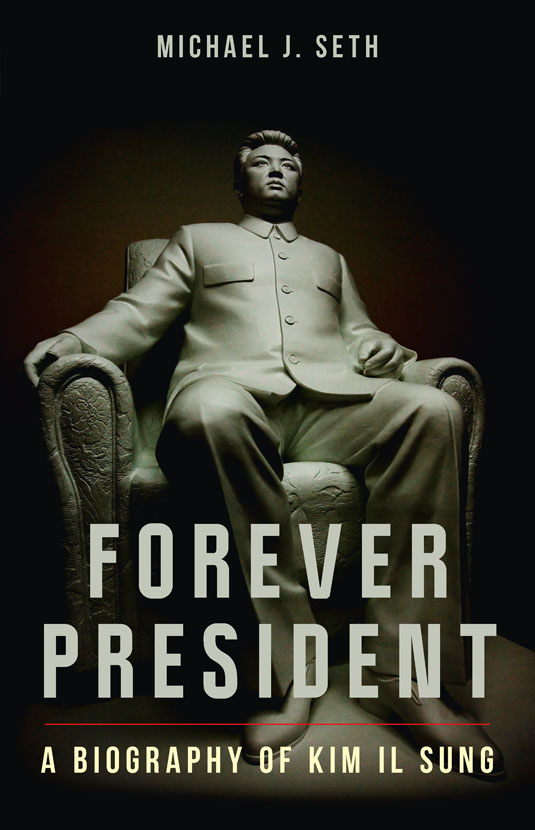
Cover image: Reaktion Books, 2025
Biographies of Kim Il-sung are like buses; you wait decades for one, and then three come along at once. Following journalist Bradley Martin’s study of the North Korean leader in 2004 (Under the Loving Care of the Fatherly Leader: North Korea and the Kim Dynasty), there had not been an English-language treatment of Kim until the arrival of Fyodor Tertitskiy’s pioneering work early last year (Accidental Tyrant: The Life of Kim Il-sung). Michael J Seth’s book represents the second in a recent, unlikely trilogy, with journalist Jonathan Cheng due to publish his own biographical work on Kim (Korean Messiah: Kim Il-sung and the Christian Roots of North Korea’s Personality Cult) later this month. Thus, after a gap of 21 years, three Kim studies are to be published in less than 18 months.
As such, comparisons between these works should be expected and, in short, Seth’s book pales in comparison to Tertitskiy’s effort. No wonder Forever President cites Accidental Tyrant as often as it does. Sources remain the most significant issue throughout Seth’s new work. An early clue the reader is about to be shortchanged comes on page six: Seth, in the book’s early section on sourcing, notes that Forever President relies on Kim’s autobiography, With the Century, in reconstructing the early life of the North Korean leader, stating:
Much of its content is self-promoting propaganda; some of it is pure fabrication that is easy to dismiss. But some can be verified by other sources, and it does provide revealing information about his early years that cannot be found elsewhere, even in the many official biographies (p. 6).
It’s a line similar to that used by Martin in his 2004 work Under the Loving Care of the Fatherly Leader.[1] However, this manoeuvre is more unexpected from Seth, a professor of East Asian History, than Martin, a journalist. What follows is a first chapter in which 29 of a total 56 endnotes – a little more than 50 percent – derive from the autobiography of Kim, a political leader responsible for the most far-reaching personality cult in recent history. As a result, the first sentence of the book is factually questionable: Seth claims Kim was born in Mangyongdae, outside of Pyongyang, repeating a North Korean claim that Tertitskiy all but debunked in Accidental Tyrant.[2]
Had Seth sourced a greater variety of North Korea-produced Kim biographies and compared their shifting factual details over time, from the earliest in the 1940s up to With the Century in the early 1990s, Forever President may have teased out new insights and biographical anomalies with which to work. Instead, where Seth relies on Kim’s autobiography only, which is often, the author leans on conjecture in trying to decipher what may be historically factual. Reviewing early biographical details, Seth lets claims by Kim stand as fact. For example, the author states Kim and his family relocated from Korea to Manchuria after his father was released from prison in 1919 (p. 25), and that Kim’s younger brother Kim Yeong-ju was born in 1920 (p. 21), both claims taken from With the Century. This chronology strongly indicates that Kim Yeong-ju would therefore have been born in China, an apparent contradiction in Kim’s autobiography which is left unexplained by Seth. Claims in earlier North Korean biographies that Kim departed Korea for northeastern China much later, in the mid-1920s, are also not considered, nor are these works cited at all in the book.
The first three chapters of Forever President frequently cite the work of Charles K. Armstrong, the once celebrated scholar on Korea who was forced to retire from Columbia University in 2020 following confirmed instances of plagiarism (and later, sexual harassment of a female student). These plagiarism findings mostly related to Armstrong’s work Tyranny of the Weak: North Korea and the World, 1950-1992. Although not cited by Seth, the author’s frequent usage of Armstrong’s other work, and reliance on the latter’s data and supposedly cold facts, rather than arguments, does leave the reader with a bad taste. Could not other sources have been used in their place? (For more on Sino-NK’s own interactions with Armstrong, see here).
Glossing and synthesising secondary sources ought to be part of any biographer’s repertoire, but over reliance on second-hand data remains an all-too-prevalent feature of Seth’s work throughout. In addition to Armstrong and Tertitskiy, the author cites a string of Korea scholars including Andrei Lankov, Wada Haruki, Suh, and the productive duo of Robert Scalapino and Lee Chong-sik. Given the fragmented early life history of the book’s subject, with years spent in colonial Korea, Manchuria, the USSR, and back in post-colonial Korea, biographical studies of the North Korean leader have tended to focus on just one era. Wada, for instance, has specialised in archival documents of his native Japan covering Kim’s life under colonial rule in Manchuria. As such, each and every one of these scholars has added new material to Kim’s patchwork biography, over decades. As a result, we have a fuller picture of the life of the North Korean leader today than we did 40 years ago, the result of countless hours of research, and wading through hagiographies, including With the Century, for historical clues and leads.
Forever President instead utilises a disproportionally high number of secondary sources, and there is no apparent new archival work to speak of here. The net result is a book which offers little in the way of new material on Kim’s life, and thus fails to add to broader understanding of the man who shaped the DPRK. Seth’s work instead serves as a reader on Kim, with significant flaws, and possibly an introduction to secondary works.
The author’s lived and studied understanding of the Koreas, and professional experience writing reference books and histories on the peninsula, smooth the prose and make it eminently readable. In turn, there are worthwhile, and occasionally original anecdotes and factoids throughout which help the reader conceptualise the time and place under discussion. For instance, the book cites longtime North Korean ideologue Hwang Jang-yeop and his return from the USSR to Pyongyang after the Korean War to portray “shock” at the rubble left where the North Korean capital once stood, a victim of American bombing (p. 126). Similarly, Seth cites the Korean-language biography of Kim Jong-il’s sister-in-law, Seong Hye-rang, who in her four post-war years at Kim Il-sung University spent a year and eight months studying, and the remainder on construction sites rebuilding Pyongyang (p. 128). Here, Seth expertly distils North Korean experiences of the period.
Yet these moments of insight fail to compensate for the overall feeling that Forever President over-relies on With the Century, thereby absorbing factual distortions, while failing to make sufficient academic impact in regards to Kim’s life. As a result, the book becomes difficult to justify – not least because of the richer scholarly alternatives already in print.
[1] Martin states that his approach included “tentatively accepting the plausible” when it came to Kim’s autobiography, see: Bradley K. Martin, Under the Loving Care of the Fatherly Leader: North Korea and the Kim Dynasty (New York: St. Martin’s Griffin, 2004), p. 12.
[2] Fyodor Tertitskiy. Accidental Tyrant: The Life of Kim Il-sung (London: Hurst and Co, 2025), pp. 61, and 113.



That drive-by you just published dismissing my work of 13 years with a single short quote taken out of all context seems to me uncalled for. Here is what I said about the Kim Il Sung memoirs in Chapter Two of Under the Loving Care of the Fatherly Leader (which is available in your local library and digitally from various outfits including Amazon):
Concocting a mythology around the nation’s founding father is by no means a North Korean monopoly. Think of George Washington’s fictional confession to having chopped down his father’s cherry tree: “I cannot tell a lie.” But while Americans and Europeans in recent decades moved in the opposite direction, gleefully felling the mighty, North Korea’s official hagiographers carried to previously unknown heights the art of building up the leader.
Western and South Korean historians have despaired of being able to separate historical truth from the Pyongyang regime’s innumerable distortions and fabrications about Kim Il-sung’s life, especially his childhood and youth. Lacking verifiable facts beyond the most basic, they have tended to dispose of Kim’s first two decades with a few sparse paragraphs before moving along quickly to the events of his adult life — for which, at least, there are sources such as contemporary newspaper accounts and the records of foreign governments.
However, in the years immediately preceding his death in 1994, Kim produced several volumes of memoirs that offer a somewhat franker, more down-to-earth account than his sycophantic writers had provided in earlier official biographies.
To be sure, many exaggerations and distortions remain even in the newer volumes. For example, whatever quantity of disbelief the reader has managed to suspend may come crashing down at an account of bandits capturing Kim’s father and two companions. While the bandits smoked opium in their camp, Kim wrote, one captive put out the lamp and helped the other two escape before “attacking the rascals, some ten in all, with skillful boxing. Then he made off from the den of the bandits.” It was, enthused Kim, “a truly dramatic sight, resembling a fight scene in a movie.”
Indeed. No doubt it is a fight scene in at least one of the countless North Korean movies glorifying Kim and his family. Hwang Jang-yop, a leading North Korean intellectual who defected to South Korea in 1997, reported that the memoir had been “created by artists who had been writing scenarios for revolutionary novels and films. Thus it made for very interesting reading. When Part I was published it was a huge hit. This was only natural, since its contents were literally scenes straight out of the movies that had been made for the same purpose, and its plot was as interesting as any novel or film.” Hwang termed the series a “masterpiece of historical fabrication.”
But there is gold among the dross in the memoirs. Some passages can be checked against the recollections of contemporaries — and those passages are found to offer more truthful portrayals than we had been accustomed to getting from Pyongyang.
Endnote to the above:
Kim Il Sung’s With the Century, was published serially by Pyongyang’s Foreign Language Publishing House. The first two volumes were released in limited numbers in 1992, in Korean as well as in English and Japanese translations. Volumes 3 and 4 were published in 1993, volume 5 in 1994 and volume 6 in 1995. Those six volumes (which apparently had only small printings in the English version and are difficult to find outside North Korea) take Kim’s story from his birth in 1912 up to the late 1930s, when he was a guerrilla commander in Manchuria. Page references here are to the English version.
Thanks to Kim’s newfound concern for accuracy, With the Century is a very important and welcome new resource. Nonetheless, in an attempt to produce a truthful account for presentation in the present work, I have found it necessary even with these relatively forthright memoirs to hack through embellishments, anecdotes that do not ring true and out-and-out prevarications ranging from minor fibs up to Big Lies in which Kim claims that he defeated the Japanese to liberate Korea, and that the Americans and South Koreans started and then lost the Korean War. Part of the winnowing process involved comparing Kim’s latest claims with his earlier claims and with the findings of outside scholars, whose works are cited at appropriate points.
In the preface (Vol. 1), Kim described the genesis of the work as follows: “Now that a large part of my work is done by Secretary for Organizational Affairs Kim Jong-il, I have been able to find some time. With the change of generations, veteran revolutionaries have departed from this life and the new generation has become the pillar of our revolution. I came to think that is was my duty to tell of the experiences I have gained in the common cause of the nation and of how our revolutionary forerunners gave their lives in their youth for this day. So I came to put down in writing what has happened in my life, a few lines each time I found a spare moment.”
Be that as it may, he clearly had considerable help with the memoirs, as Hwang suggested. Omaha, Nebraska, pathologist Won Tai Sohn, Kim’s friend from Jilin days, told a U.S. newspaper interviewer that during one of his 1990s visits to Pyongyang a professor from North Korea’s History Research Institute had tagged along for every meeting, taking notes on the Great Leader’s recollections as the conversations progressed. See Geraldine Brooks, “Two Old Friends: One Became A Doctor, the Other a Dictator,” The Asian Wall Street Journal, Sept. 19, 1994. (In correspondence with me, Dr. Sohn, who knew Kim in his middle-school days in the Chinese city of Jilin, said: “Had I written about my days in Jilin, I would have written just the same as he did.”)
Whether his helpers merely researched and edited the work or, as seems more likely, actually ghostwrote it, their contributions are evident in the provision of considerably detailed historical background for periods and episodes that Kim touches upon — background that even the all-powerful North Korean leader would not likely have had at his fingertips, even if he had enjoyed the leisure to pore over his records. For example, when Kim describes his transfer to Yuwen School in Jilin in January 1927 (Vol. 1, p. 208), he refers to the files of a Chinese newspaper, Jizhang Ribao, for accounts of the school that had appeared in its pages years before his enrollment.
One helper allegedly was South Korean dissident novelist Hwang Suk-young, who visited North Korea numerous times without his government’s permission while living abroad in the 1980s and ’90s. When he returned to South Korea in 1993, professing satisfaction that President Kim Young-sam had inaugurated a “civilian” regime after the years of military-backed government, Hwang was arrested, tried and sentenced to seven years’ imprisonment for violating the national security law. One of the charges was that during his final stay of six months in the North he had “participated in the writing” of With the Century, which the prosecution deemed “a pro-enemy publication praising Kim Il-sung and North Korea.” [South] Korean Overseas Information Service, Backgrounder No. 126. Oct. 12, 1994.
Perhaps thanks to the involvement of such professionals as novelist Hwang, much of With the Century is a cracking good read, laced with adventure sequences, humorous anecdotes and vignettes of people Kim encountered.
For more on the significance of these memoirs see Bradley Martin, “Remaking Kim’s Image,” Far Eastern Economic Review, April 15, 1993, and the author’s similar Korean-language article, “Revisionism in Pyongyang,” Newsweek Hankuk-pan, April 1, 1993.
Bradley, thank you for your comment. Sino-NK welcomes a Q&A or discussion with you on your book ‘Under the Loving Care of the Fatherly Leader’, your thoughts on Kim Il-sung biographies past and present, and anything else DPRK related – for publication on this site, in full, for our readers. Do let us know your response to these invitations.
Thanks for the invitation, Stephen, but your all-too-typical grad-student disdain for the work of those of us who continue in your former trade persuades me that interacting with you as you propose probably would not be a fruitful use of my time. You write of the Seth book, starting with a quote from its author:
“‘Much of its content is self-promoting propaganda; some of it is pure fabrication that is easy to dismiss. But some can be verified by other sources, and it does provide revealing information about his early years that cannot be found elsewhere, even in the many official biographies’ (p. 6). It’s a line similar to that used by Martin in his 2004 work Under the Loving Care of the Fatherly Leader.[1] However, this manoeuvre is more unexpected from Seth, a professor of East Asian History, than Martin, a journalist.”
To make your name by attacking my book and my methods, you’d better start with something you think I got wrong. It’s been over two decades since publication and I’ve been approached with no more than a handful of minor quibbles. As you know, as the owner of a copy of my book, I, unlike Seth, did NOT say that Kim was born at Mangyongdae.