Diplomatic Review, Q2 2026: Amplifying Xi Post-Pyongyang
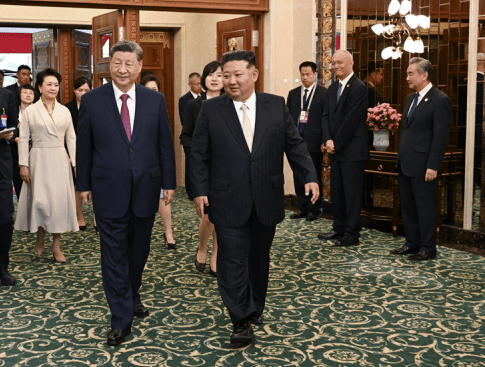
Chinese President Xi Jinping (left) meets with North Korean leader Kim Jong-un in Pyongyang in June | Image: Xinhua.
Following Chinese President Xi Jinping’s visit to the DPRK in June, the first in seven years, China has held a series of unprecedented events designed to promote and explain the trip, as diplomacy accelerated with a series of high-level bilateral meetings in Beijing and Pyongyang.
The rapid succession of high-level contact between China and North Korea, including two meetings between Xi and Kim in just nine months, represents the most intense diplomacy between the countries since a series five meetings were held between the two leaders across a period of just 15 months in 2018 and 2019 ahead of Kim’s talks with US President Donald Trump.
The DPRK’s second-ranked official, First Vice President of the State Affairs Commission Jo Yong-won, attended a Chinese Embassy event in Pyongyang to mark the 105th anniversary of the Chinese Communist Party on 30 June. Two weeks later, Jo then hosted a Chinese delegation in Pyongyang led by Politburo Standing Committee member Wang Huning, China’s fourth-ranked CCP official.
The delegation paid a visit to North Korea to mark 65 years since the two countries agreed a ‘Treaty on Friendship, Cooperation and Mutual Assistance’, a defence pact signed by Chinese Premier Zhou Enlai and North Korean leader Kim Il-sung in Beijing in 1961. North Korea and Russia signed a similar treaty in 2024 to replace their Soviet-era pact which ended with the dissolution of the USSR in the 1990s.
Treaty anniversary meetings in Pyongyang also saw Wang meet with DPRK Premier Pak Thae-song, who a week earlier made a visit to Beijing to hold talks with Xi, his counterpart Premier Li Qiang, Chairman of the National People’s Congress Zhao Leji, and Politburo Standing Committee member Cai Qi.
Xi told Pak,
That the current international situation is complex and volatile. China and North Korea should maintain strategic resolve, strengthen strategic confidence, accelerate the implementation of the consensus reached between himself and General Secretary Kim Jong-un, and ensure that relations between the two parties and countries keep pace with the times, always developing in a direction conducive to consolidating their respective socialist causes and promoting their respective national modernisation.
This is the first time Xi has used the term “strategic resolve” (战略定力) in relation to the DPRK, and describes not only bilateral ties between these two countries, but a shared ideological and geopolitical position amid the “complex and volatile” global climate. Xi’s reference to party relations continues China’s recent amplification of inter-party rhetoric in relation to North Korea.
The two most senior Korean Worker’s Party officials directly below Kim – Jo and Pak – therefore held multiple meetings with five of the seven members of China’s Politburo Standing Committee, the CCP’s most powerful body, within just a few weeks of Xi’s visit to North Korea in June. These high-level, overlapping talks between China and the DPRK frequently referenced Xi’s dialogue with Kim, and were ostensibly held to mark the anniversary of the founding of the CCP and the defence pact signed between the two countries. Yet, the unusually high frequency of these exchanges indicates that rhetoric around their “new era” of friendship, as referenced by Xi in Pyongyang, has become in increasingly apparent in recent diplomacy between China and the DPRK.
All Roads Lead to Xi

China’s Ambassador to the DPRK Wang Yajun (centre) hosts a diplomatic briefing on Xi’s visit to North Korea at the Chinese Embassy in Pyongyang in June | Image: Chinese Embassy in North Korea.
Xi’s June visit to Pyongyang has also led to additional unprecedented events and exchanges which further indicate Chinese efforts to strengthen its diplomatic sway with North Korea against the backdrop of renewed ties between Pyongyang and Moscow. A week after the Chinese president departed the DPRK, China’s Ambassador Wang Yajun hosted a diplomatic corps briefing on the outcomes of the visit, inviting ambassadors from nearly 40 countries including those of Russia, Cuba, Iran and Sweden. China clearly wishes to amplify key messages from the visit with foreign partners of North Korea, including Russia – by contrast, China did not host a similar event following Xi’s visit to North Korea in 2019, and full diplomatic briefings of this kind remain highly unusual.
Frequently citing Xi, the Chinese ambassador told Pyongayng’s diplomatic corps:
As General Secretary Xi Jinping pointed out, China will work hand in hand with North Korea to write a new chapter, allowing the traditional friendship between China and North Korea to shine even more brightly in this era, and making greater contributions to promoting regional and even global peace, stability, development and prosperity.
Wang Yajun then on 1 July hosted what the embassy termed a ‘symposium on the exchange of party building experiences between China and North Korea’ (中朝党建经验交流座谈会). Although a Chinese Embassy announcement on the symposium said it coincided with the 105th anniversary of the founding of the CCP, no such symposiums with the same or a similar title are known to have been held previously between the two countries, whether on CCP anniversaries or otherwise. The event follows the similarly unusual visit made to the KWP Central Cadres School in Pyongyang by Xi and Kim in June, and further indicates that China is pressing inter-party exchanges with the DPRK as a means to re-assert Beijing’s influence over Pyongyang amid recent closer North Korea-Russia tie, as previously noted by Sino-NK.
The symposium was led by Chinese Ambassador Wang Yajun, and Vice Director of the International Department of the Central Committee of the KWP Moon Song-hyeok. The choreography – with two sides lined up along tables facing each other – had the manner of a high-level diplomatic exchange, and included a back-and forth in which the Chinese embassy praised the CCP and the KWP. An account of the meeting by the Chinese Embassy in Pyongyang noted that,
China is willing to work with North Korea to implement the important consensus reached by the top leaders of the two parties, carry forward the fine tradition of “frequent visits and increasingly close ties” between the two parties, deepen inter-party exchanges and cooperation, conduct mutual learning and exchange, and promote the continuous achievement of new successes in their respective socialist causes.
At the end of the symposium, the two groups exchanged works by their respective parties and leaders, with Wang Yajun offering a copy of the Chinese president’s work Xi Jinping: The Governance of China.
The net result of the meeting, and recent high-level exchanges between China and North Korea, is that China is not only more actively promoting inter-party interactions and dialogue, it is also increasingly exposing North Korean party officials to the comments, speeches, and works of its leader Xi. Ahead of his visit to North Korea in June, the Chinese president wrote an article on the front page of the main KWP newspaper Rodong Sinmun in which he made no mention of denuclearisation of the Korean Peninsula, and instead focused on ties between their two parties, as reported by Sino-NK.
Increasing inter-party dialogue follows comments by Kim on a visit to Beijing in September of last year during which he told Xi that North Korea wished to exchange experience with China on “party-building and economic development”, according to an account of the meeting by China’s Foreign Ministry.
Ambassador Promotes Xi Visit with Chinese Diaspora
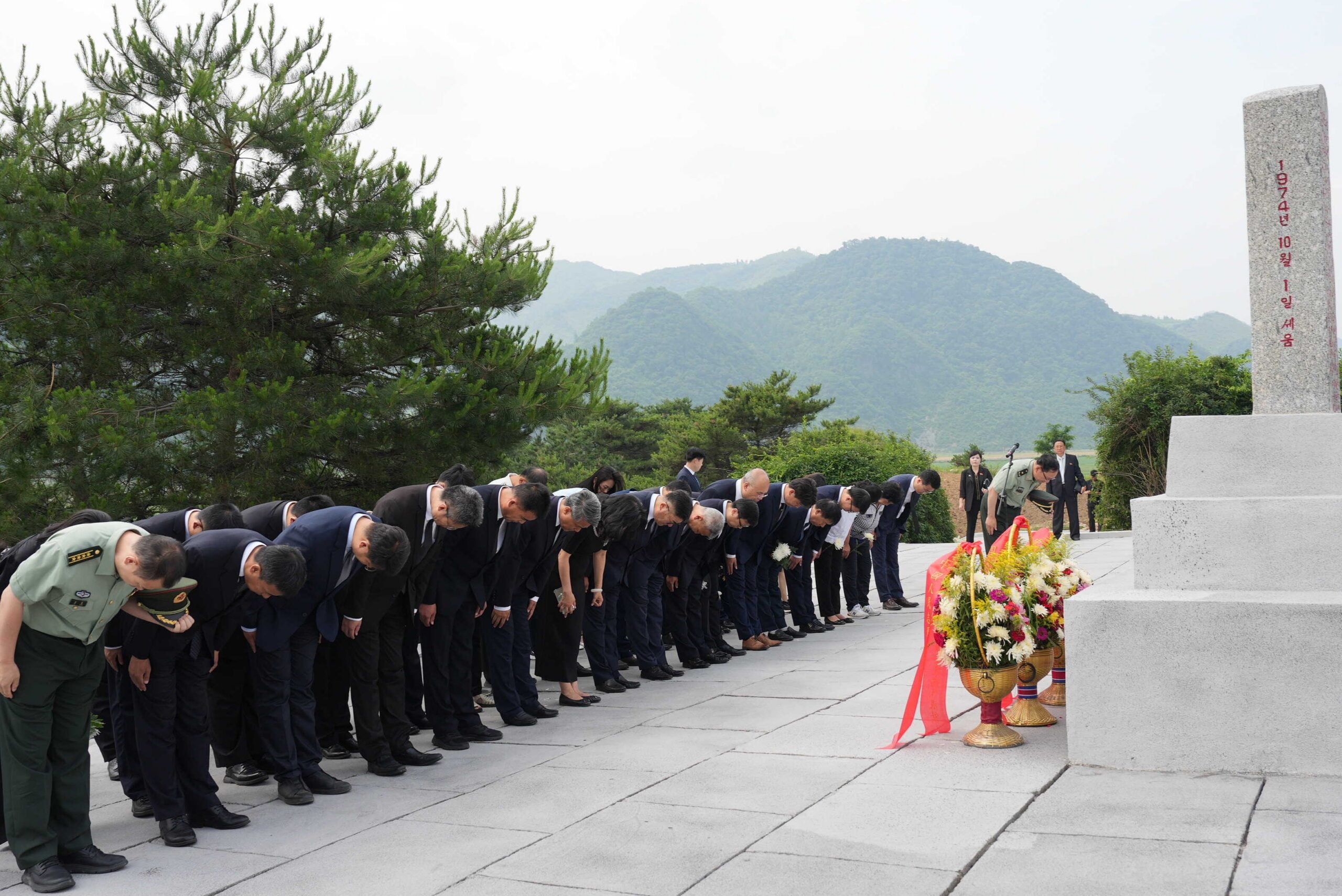
China’s Ambassador to the DPRK Wang Yajun (centre) bows at the monument to the CPVs in Tokchon, North Korea in June | Image: Chinese Embassy in North Korea.
Following the conclusion of Xi’s landmark DPRK visit, Wang Yajun began a tour promoting the trip and its outcomes with the Chinese community in North Korea. This began with an embassy briefing to more than 100 Chinese civilians and students on June 15. Over two days, the Chinese ambassador then toured Tokchon City in South Pyongan province to meet with overseas Chinese families, and led a commemorative ceremony at the Chinese People’s Volunteers monument in the same city attended by additional Chinese groups. The embassy explicitly connected maintenance of the cemetery with the agreements reached during Xi’s visit. Wang Yajun said China and the DPRK should preserve CPV memorials and use them for “revolutionary tradition” and youth education. China’s ambassador added,
He hoped that overseas Chinese would seize the opportunity presented by the vigorous development of China-North Korea relations, actively participate in the socialist construction of both countries, and contribute to the friendly cooperation between China and North Korea.
Tokchon and its Chinese population have become a regular fixture for Chinese diplomats touring North Korea after the CPV memorial was erected there in the mid-1970s. In 2009, then Chinese ambassador Liu Xiaoming visited the city after two Chinese brothers lost their home to a fire, with the embassy donating aid to the family.