Back to the Party: Xi in Pyongyang, and Renewed Emphasis on CCP-WPK Ties

Chinese President Xi Jinping waves to the North Korean public besides counterpart Kim Jong-un in Pyongyang on 9 June, 2026. | Image: Xinhua.
Master narratives abounded last week when Xi Jinping undertook his first state visit to the DPRK since 2019. Western coverage largely interpreted Xi’s appearance on the peninsula as an effort to reassert Beijing’s relationship with Pyongyang and rebalance back from Vladimir Putin’s recent advances to Kim Jong-un. Indeed, in China, there was a mostly-deafening silence when it came to mentions of Moscow (the proverbial Russian elephant in the room) amid the welter of news reports and analyses. Instead, Beijing media favoured a focus on Party-building and future strategic coordination in what was termed “a new era”. If Chinese reports and analyses omitted the Russia connection, those in the West played it up while often failing to fully digest the inter-Party significance of Xi’s visit.
Xi’s near identical visit to Pyongyang seven years ago, in June of 2019, serves as a reminder of key changes in the bilateral relationship since, and how Xi and the CCP now approach Kim following the insertion of Putin into Northeast Asia’s shifting geopolitical equation. Both state visits saw Kim visit Pyongyang over two days, with meetings between the two leaders at the Kumsusan Guesthouse, even during the same month. But the differences otherwise were stark, and serve to reflect Xi’s shifting focus on the DPRK.
In 2019, amid talks between Kim and US President Donald Trump, and the pressing issue of denuclearisation of the DPRK, China’s main CCP newspaper Renmin Ribao couched the visit in terms of “friendship” and the “Korean peninsula issue”, the latter a reference to North Korean nuclear weapons. In all, there were more than a dozen references to Kim’s nuclear arsenal, overt or otherwise.
Fast-forward to 2026, and the nuclear proliferation issue has been dropped entirely from CCP newspaper reporting on the visit in China. In fact, this absence should be no surprise, as it comes after China’s State Council also dropped mentions of denuclearisation from its white paper on national defence in December, as noted by Sino-NK.
Instead, last week’s Renmin Ribao coverage of Xi’s visit gave significant emphasis to socialism and party-to-party contact between the two nations, and to a much greater degree than in 2019. While Chinese reporting on both visits identified the two countries as socialist in nature and led by Communist parties, reporting in 2019 spoke of promoting “the political settlement of the Korean Peninsula issue”, while the 2026 edition instead used the following phrases:
要从社会主义前途命运的战略高度, meaning “we must view matters from the strategic height of the future and destiny of socialism”, and;
携手开辟两国社会主义事业更加美好的前景, which translates as “jointly open an even brighter future for the socialist cause of both nations”.
China and the CCP have therefore begun to more greatly emphasise shared socialism with the DPRK, while dropping the nuclear issue altogether. Viewed in terms of current geopolitical dynamics, it would be tempting to conclude that the CCP has decided to draw repeated attention to socialism because it’s a key political consensus shared between China and the DPRK, and one dropped long ago by Moscow with the end of the Soviet Union 35 years ago. In other words, China and North Korea are socialist comrades, past and present; the DPRK and Russia are not.
Party School Politics
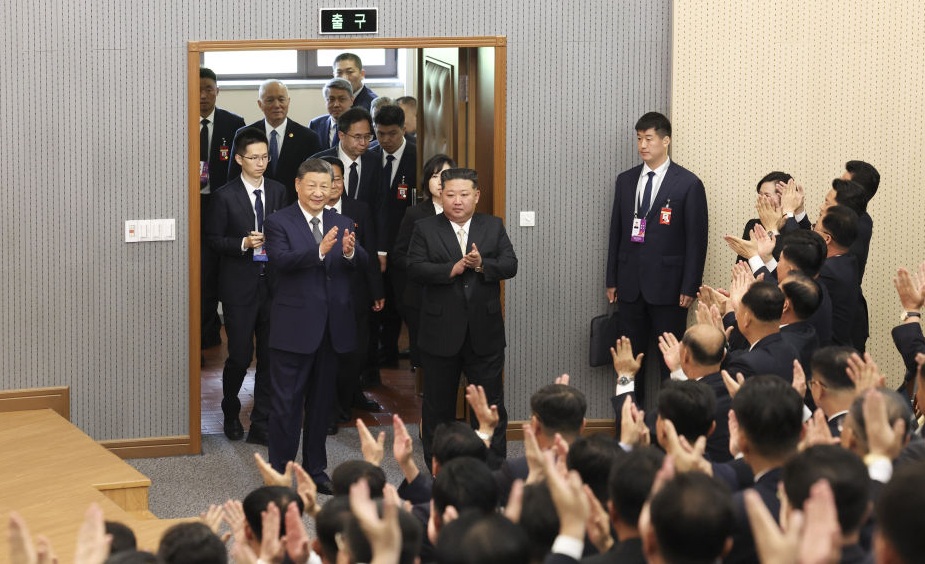
Xi arrives at the KWP Central Cadres School in Pyongyang on 9 June, 2026. | Image: Xinhua.
Xi’s itinerary further empathised the key Party theme of his state tour of the DPRK. The Chinese leader paid visit to the Korean Workers’ Party Central Cadres School in Pyongyang where students “sat attentively as the instructor lectured on the topic of China-North Korea relations”, according to an article in Renmin Ribao. It added: “Xi Jinping and Kim Jong Un paused to observe the lecture, nodding in approval from time to time.” Renmin Ribao concluded its coverage of the cadres school visit with an arboreal element, of interest to readers of environmental politics:
Arriving at the wooded area between the teaching buildings, Xi Jinping and Kim Jong Un jointly shoveled soil and watered a fir tree. The evergreen fir tree symbolizes the enduring friendship between China and North Korea. Subsequently, witnessed by the top leaders of the two parties and countries, Cai Qi and Kim Jae-ryong, member of the Political Bureau Standing Committee and Secretary of the Central Committee of the Workers’ Party of Korea, jointly unveiled the tree-planting monument. The front of the monument is inscribed with the words “Eternal Friendship Between China and North Korea” in both Chinese and North Korean.
Xi made no such visit to the Korean Workers’ Party Central Cadres School in 2019. In another key divergence from its messaging in 2019, last week the Renmin Ribao backed Kim personally as leader of the DPRK with the phrase:
对金正恩总书记同志领导朝鲜社会主义事业的坚定支持不会改变, which asserts that “China’s firm support for Comrade Kim Jong-un’s leadership of the DPRK socialist cause will not change”.
Again, no such personal endorsement was made of the North Korean leader when Xi visited seven years ago. Overall, the narrative from China this time emphasised the importance of leader-to-leader exchanges, and Party connections down to the grassroots of the CCP and KWP, as shown by Xi’s visit to the cadres school. During Xi’s most recent trip to the DPRK there was little emphasis on trade, with far more weight afforded to the themes of political trust, exchange, and coordination.
China’s messaging in this regard extended to Xi’s own signed article which appeared in both China’s main Party newspaper, the Renmin Ribao, and on the front page of North Korea’s own Party newspaper, Rodong Sinmun. China’s decision to coordinate with North Korea to publish an article by Xi in both newspapers mirrors the approach taken for the Chinese leader’s state visit to the DPRK in 2019.
Again, the content from seven years ago contrasts sharply with that of last week, with Xi’s personal article in 2019 placing emphasis on China coming as a friend to North Korea to discuss the nuclear issue. In 2026, again repeating the content and tone of official coverage of the visit, Xi dropped the nuclear issues entirely, and instead made 10 references to “socialism”, and nine to “Party’”, as in the CCP and WPK.
When Putin visited Pyongyang two years ago, in June 2024, he also wrote an article which appeared on the front page of the Rodong Sinmun, entitled: “Russia and the DPRK: Traditions of Friendship and Cooperation through the Years.”
But while Putin has competed with Xi when it comes to direct political messaging to North Korea’s political elite through its main newspaper, Russia has otherwise been unable to tap North Korea’s Party infrastructure for its own political ends. Russia may have re-embraced authoritarianism under Putin, but its Party infrastructure was abandoned decades ago. In re-emphasising Party roots and connections, Xi appears to have sought a formula to return North Korea to China’s sphere of influence, and to remind Kim of Russia’s divergent politics.
In abandoning all mention of the nuclear issue, while personally referencing support for Kim as leader of the DPRK, Xi and China have significantly changed their approach with Kim. After all, successive Chinese leaders – Hu Jintao and Xi himself – declined to meet the young North Korean leader for more than six years following his ascension to power in late 2011.
This monumental shift in China’s approach represents not only a significant diplomatic victory for Kim, following his grandfather Kim Il-sung in adroitly playing off Beijing and Moscow, it also highlights the degree to which Xi appears determined to bring North Korea back within China’s orbit. Apparently, Xi has decided the best way to do this is by reasserting their bilateral relationship around the Party. The question is: will it work?