An Airfield in Time: Dabao base, from the Korean War to Recommissioning under Xi

A house in Dabao near the town’s airfield as seen in June, 2017. | Image: Sino-NK.
The People’s Liberation Army (PLA) has in recent years begun reactivating and upgrading airfields in China’s northeastern provinces adjacent to the DPRK, part of a little-noticed military initiative which has in some cases revived facilities dating back to the Korean War.
In April, Dandong-Langtou Airport in Liaoning province reopened after completion of a runaway extension, now 2,800 metres in length, for dual civilian-military use. A similar project at Qiqihar Sanjiazi was completed in 2022, and a new runaway at Mudanjiang Hailang Airport is currently under construction, both in Heilongjiang province.
Overall, at least eight such projects have been launched in Liaoning, Jilin, and Heilongjiang during the past decade, according to public domain research by Sino-NK.
Among the most historic, and least noticed, has been Dabao Airfield (also known as ‘Dapu’), 50km from the North Korean border in Liaoning. After decades of inactivity, the PLA returned to the base in 2019 to begin upgrades ahead of recommissioning, according to research by Sino-NK using satellite imagery and public domain sources in Chinese.
The below satellite image shows the base, and adjacent Dabao town to the right, in February, 2019, as it lay dormant and unused more than 30 years after the PLA ceased activity at the site in the late 1980s.
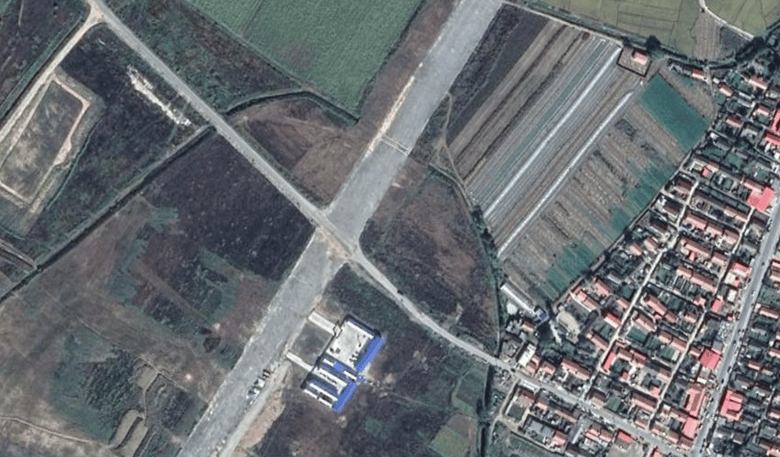
Dabao Airfield, February, 2019. | Image: Google Earth.
Reconstruction of the airbase began soon after this image was captured, led by PLA Unit 65529 in Fengcheng, which contracted companies including China Metallurgical Group No 3 to rebuild parts of the facility in 2019. The initiative was known as ‘Project 3748’.
Another satellite image below, captured in July of 2020, shows the same area after construction had been completed on the first phase of the site’s redevelopment. The top-left side of the image shows newly constructed buildings, and helipads. A helicopter can be seen stationary, left of centre in the image, a clear indication Dabao had been recommissioned.
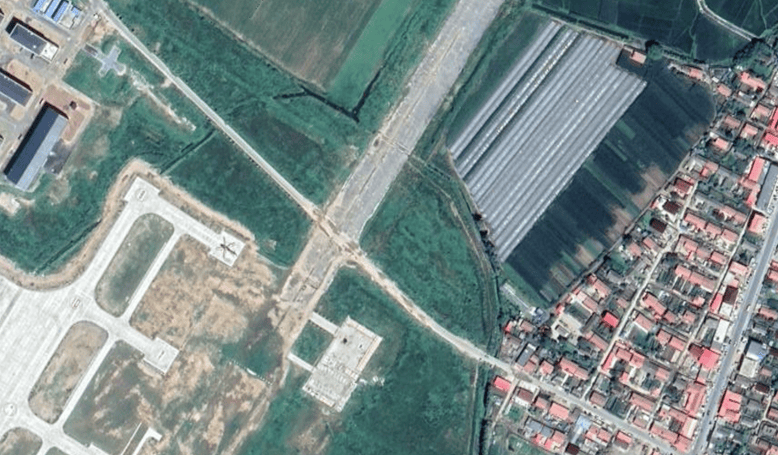
Dabao Airfield, July, 2020. | Image: Google Earth.
By October of the same year, a Chinese Army Aviation unit had already been deployed to the newly recommissioned base, as noted by Xinhua in a visit to record its history.
Dabao has since served as an active PLA Ground Force Army Aviation helicopter airfield under the Northern Theatre Command, and is used as a secondary facility of the 79th Group Army’s Army Aviation Brigade stationed in Liaoyang. In September 2018, about a year before Dabao construction work began, Chinese President Xi Jinping visited the 79th Group Army in Liaoyang, and boarded a Z-10 attack helicopter. It remains unclear whether Xi’s visit was tied to the expansion of the 79th Group Army to Dabao, and the site’s recommissioning.
By 2024, older, original structures within the Dabao complex had been formally protected as cultural relics, and incorporated into Dandong’s broader list of Korean War ‘red heritage’ sites, used for defence and history education, and related patriotic activities.
A Key Airbase in the Korean War
Dabao was first built in 1950, months after Mao Zedong had declared the ‘New China’ in October of the previous year. As the country began to build up its new Airforce following the start of the Korean War, Dabao was quickly prioritised and upgraded as a new MIG jet fighter base operated with the Soviets, mainly because of its location close to the border with the DPRK. In June of 1952, Soviet pilots of the 133rd Fighter Aviation Division were deployed to forward airfields at Dandong and Dabao, as noted by Zhang Xiaoming in his book Red Wings over the Yalu: China, the Soviet Union, and the Air War in Korea. “They engaged in their first large battle with Sabres [of the US Airforce] on 1 August [1952],” according to Zhang’s account.[i]
Between mid-1952 and the end of the conflict a year later, Dabao became one of four key airfields in northeastern China which contributed to the deployment of communist jets to the area of the DPRK just south of the Yalu River, what became known as ‘MIG Alley’ by US forces.
On 19 July 1953, a group of Sabres flew into Chinese territory and attacked the Dabao airbase, causing the Soviets to scramble its own fighters from the airstrip. Led by Major Semyon A Fedorets, the communist planes downed a USAF Sabre at the site. Just eight days before the signing of the armistice, this would be the last USAF Sabre shot down by a Soviet pilot during the Korean War.[ii]
A Visit to Derelict Dabao

The old control tower at Dabao Airbase sits derelict and abandoned in June, 2017, two years before the site was recommissioned by the PLA. | Image: Sino-NK.
By chance, in June of 2017, Sino-NK visited Dabao airfield before its reconstruction began two years later. Liu Xuefu, a 92-year-old railway worker who helped build a new train station connecting to the airfield during the Korean War in 1952, said rumours were circulating in Dabao during 2017 that the PLA was about to return to the base. Local farmers had been instructed not to plant their crops in the area because of these plans, said Liu, whereas they had been permitted to do so just a year prior.
In mid-2017, Dabao remained deserted with no signs of the airbase’s imminent recommissioning, its long, potted runaway connecting to a road which led to the town of Dabao in the distance. The old control tower and surrounding buildings remained in a state of ruin, crumbling and overgrown. Outbuildings, which decades earlier housed PLA soldiers, contained odd shoes, leaflets dating back to the 1950s and 1960s, cooking utensils, and pieces of old clothing. There were old sheds which decades earlier housed livestock, including horses which provided transport for the PLA troops stationed here, and farm animals for food. In another room, copies of the People’s Daily dating back to the year 2000 were stuck to a wall, an indication that people had lived on site more recently, even though officially the PLA had stopped all activity here by the late 1980s.
Political Slogans Captured in Time
Slogans painted on some of the buildings at Dabao airbase indicate that the site remained active following the end of the Korean War, even if the conflict marked its main period of use as an active, wartime military facility. As seen in the image below, the exterior of one brick building was painted with the Chinese characters:
总路线万岁/ “Long live the General Line!”

Image: Sino-NK.
The term first came into common political discourse in China shortly after the Korean War, when the “general line” was cited by Mao as a “beacon” to guide all work of the Chinese Communist Party and state, paving the way for its wider usage on banners, and buildings. By the late 1950s and early 1960s, the ‘general line’ became one of the ‘Three Red Banners’, along with the Great Leap Forward and People’s Communes, leading to a further resurgence in usage of the term across China.
Most buildings at Dabao were painted with political slogans, with many attributed to Mao, although the majority had faded with time. Among those still visible in 2017:
建立一支强大的人民空军,保卫祖国,准备战胜侵略者/ “Build a powerful People’s Air Force, defend the motherland, and prepare to defeat the aggressors.”
Mao Zedong

Image: Sino-NK.
Although the phrase appears to relate to the Korean War, this exact formulation dates from 1955 when Mao wrote an inscription with the same wording for the First Congress of Heroes, Models, and Meritorious Personnel of the Air Force. This was a new symposium designed to honour and promote the PLA Air Force, which had only come into service during the Korean War.
Another, similar slogan attributed to Mao on a wall at Dabao reads:
政治思想工作是一切工作的生命线/ “Political and ideological work is the lifeline of all work.”
Mao Zedong

Image: Sino-NK.
Although variations on the phrase had been used for years, this exact construction was apparently first used in or by 1961, as recorded in an issue of China Youth in September of the same year. The column on page five of the journal explains that socialist construction requires the people to both master their work roles and commit to being politically “red”, using this slogan to support such action.
Dwindling Importance
In 1965, the 30th Air Division departed Dabao, and was brought back to the airfield two years later as China was engulfed in unrest and fighting during the start of the Cultural Revolution. The 30th Air Division remained at the base for a further 18 years before finally relocating to Langtou airfield on the outskirts of Dandong. By the end of 1987, all fixed-wing flying had ended at Dabao. It was from this period that the site fell into a long period of desertion, and ruin, through the end of the Cold War – until its recent revival under the administration of Xi Jinping.
[i] Zhang Xiaoming, Red Wings over the Yalu: China, the Soviet Union, and the Air War in Korea (College Station: Texas A&M University Press, 2002), 125.
[ii] Ibid, 138.