Dropping Denuclearisation: North Korea in China and US Defence Priorities

A view into North Korea at a frontier security fence near Sinuiju-Dandong. | Image: Sino-NK.
For decades, the US or China – and often both – have identified North Korea and its nuclear ambitions as a key destabiliser in Northeast Asia. Yet in the space of just a week, the world’s two principal powers have enshrined in their respective defence priorities what amounts to shifts away from concern over the DPRK nuclear issue – towards greater focus on each other.
The PRC’s State Council Information Office issued China’s latest white paper on national defence with no explicit mention of DPRK nuclear armament, or denuclearisation of the Korean Peninsula, and selected softer language. The document, published on 27 November, instead called on “relevant parties to desist from an approach based on aggressive deterrence and coercion”.
A week later, the White House issued its own ‘National Security Strategy’ which failed to mention North Korean nuclear weapons or Korean People’s Army deployments to Russia’s Kursk region. Indeed, there was no mention whatsoever of the DPRK. The document’s only nod to the Korean Peninsula consisted of three references to South Korea, urging its putative ally to spend more on defence, noting the country’s “tremendous resources” as part of a “global south” including Japan.
The 2025 edition stands in stark contrast to that published in mid-December 2017, less than a year into Donald Trump’s first presidency. That document referenced North Korea by name 17 times, the same volume as Iran. Eight years ago, the Trump White House labelled the DPRK a “rogue regime”, a “dictatorship”, a “country that starves its own people” and a state that had “spent hundreds of millions of dollars on nuclear, chemical, and biological weapons that could threaten our homeland”.
By contrast, China’s treatment of North Korea in its own defence white papers have tended to be more sober and implicit, albeit with evidence of its own frustrations at actions by Pyongyang. For years China’s defence blueprint referenced denuclearisation of the Korean Peninsula as a stock phrase, including in 1995, 2005, and 2010. Given that the DPRK represented the only party with nuclear weapons on the peninsula following the abrupt end to the Cold War, after the withdrawal of US naval and land-based tactical nuclear weapons in 1991, Beijing’s subsequent references to denuclearisation were clearly aimed at Pyongyang.
The start of Xi Jinping’s presidency in 2013 led to a shift in tone from China on its defensive assessment of the Korean Peninsula. Rather than noting the DPRK and the nuclear issue, China instead referenced the Korean Peninsula as being “shrouded in instability and uncertainty”, as in 2015, contributing to a “negative impact on the security and stability along China’s periphery”. At the time, Xi was engaged in a silent standoff with Kim Jong-un, and would ultimately not meet his counterpart in Pyongyang until five years into his presidency.
The Chinese president is widely perceived as having become frustrated with North Korea’s young leader after Kim initiated the first nuclear test of his leadership in February 2013 just weeks before China’s 12th National People’s Congress in which Xi was presented as the next leader of China. Soon afterwards, Xi issued an unusually strong denunciation stating that “no-one should be allowed to throw a region and even the whole world into chaos for selfish gains”. Any doubt that the message was directed at Pyongyang was eradicated when the Global Times, an official tabloid under Party control, stated the comment was “widely considered as targeting North Korea”.
Kim’s decision soon afterwards to execute his uncle Jang Song-thaek, a senior DPRK official with close ties to China, and to apparently assassinate his half-brother Kim Jong-nam in 2017, another family member with China connections who lived in Macau, did not help relations with Beijing.
In the meantime, China exerted its strictest-ever enforcement on UN Security Council sanctions on the DPRK in 2016 and 2017, leading to further unusually negative rhetoric in the pages of the Party press in both countries.
Nonetheless, during the entire period of Xi’s presidency Chinese white papers on its security priorities have failed to mention denuclearisation of the Korean peninsula as an explicit concern, although the passage on the Korean Peninsula published last week was placed in the section on “Nuclear Non-proliferation”, as follows:
With regard to the Korean Peninsula issue, China adopts an impartial stance and adheres to the right approach of always working for the peace, stability and prosperity of the peninsula and the resolution of the Korean Peninsula issue through political means. China calls on relevant parties to desist from an approach based on aggressive deterrence and coercion, restart dialogue and negotiations, and play a constructive role in resolving the Korean Peninsula issue through political means and realizing lasting peace and stability in the peninsula.
From the vantage point of Pyongyang, these recent defence papers from China and the US represent critical reading, and will be seen as the latest in a series of foreign policy and military wins for Kim. Having signed a mutual defence pact with Russia in mid-2024, North Korea has in the space of just a week seen both the US and China omit mention of denuclearisation on the peninsula, and the DPRK itself, from their respective, published security concerns for the first time in decades. That is to say, the governments of the three pre-eminent global nuclear powers have in a short period moved closer to North Korea, and effectively downgraded the state as a geopolitical security concern.
A key reason: the US and China have in turn pivoted towards a greater focus on each other, and at the same time relations between Beijing and Pyongyang have improved over the course of this year, catching up with considerably closer Russia-DPRK bilateral ties.
In recent months, the US has shifted its tone regarding the Korean Peninsula from previously calling on greater South Korean military expenditure and self-sufficiency, to explicitly stating that the ROK military should occupy itself with the DPRK threat while American forces in South Korea pivot on China.
This change in language has coincided with the appointment of Elbridge Colby as under-secretary of Defence Policy in April, a figure widely viewed as the current chief architect of American policy in regards to China and the Korean Peninsula. As noted by Sino-NK, Colby has publicly stated he is “in favour of reshaping US forces in the ROK to focus on China while the ROK takes the great burden of conventional defence against the DPRK”, while again ruling out US troop withdrawals from the peninsula.
Divergent Views
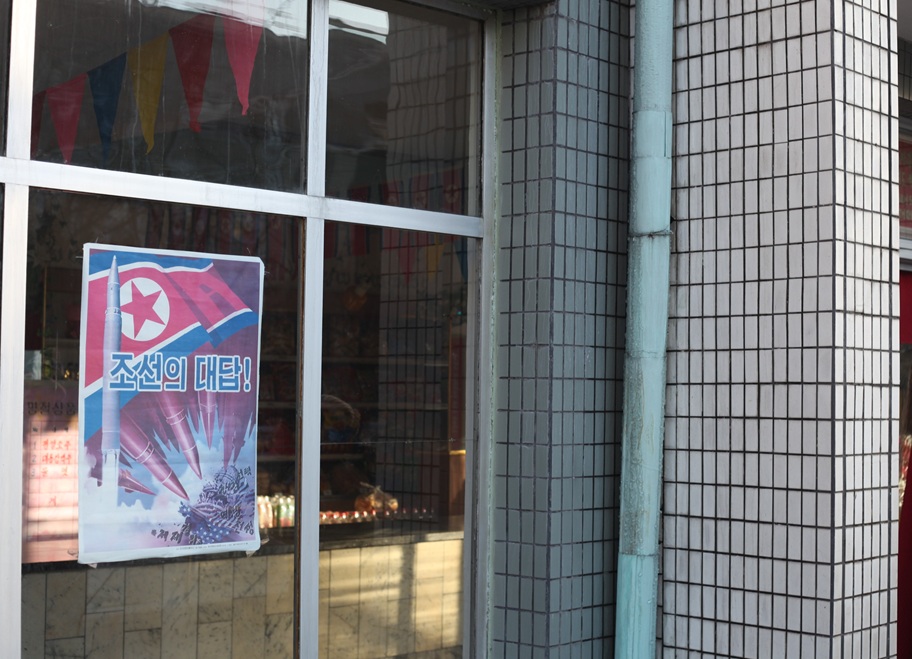
A poster in a Pyongyang shopfront depicts a DPRK attack on the White House with the slogan ‘Korea’s Answer’. | Image: Sino-NK.
Trump administration policy on North Korea appears increasingly distant from that of the US intelligence community, which earlier this year published its own annual threat assessment with language which appeared little different to proceeding years, and in some instances escalated the risk perception in regards to the DPRK. The 2025 report continued to describe Kim as an actor “trying to reshape the regional security environment in his favour”, as it did in 2024, but this year added a new qualification that the North Korean leader was able “to undermine US power” through its pursuit of “strategic and conventional military capabilities”. In 2024 and 2023, the annual US intelligence report instead termed Kim as an actor responsible for “periodic aggressive actions”, a lesser threat in relation to the US. Furthermore, in this year’s document, US intelligence deemed North Korea – and China – to be “more emboldened”, and Beijing and Moscow to have strengthened cooperation with Pyongyang, all increased risks for the US.
In terms of verifiable missile-firing and nuclear-related activity, there is little question that North Korea has slowed activity. After a record year in 2022 with more than 70 missile launches, the pace has slowed into this year with a dozen or so such events. In terms of nuclear development, the DRPK has not conducted a test since September, 2017, a period of heightened tension with both the US and China, although its related weapons capability is understood to have expanded significantly since then.
This year, China has increased high-level political contact with North Korea amid the first meeting between Xi and Kim in six years in September, and the first talks between their two premiers in 16 years the following month. As reported by Sino-NK, the border province of Liaoning and the DPRK are this year set to record their highest-ever trade, a further sign of improving bilateral cooperation.
With both China and the US dropping mention of denuclearisation on the Korean Peninsula, the DPRK is not only now seemingly less of a security priority for the world’s foremost powers, the shift in perceptions by the governments of both nations also signals growing tacit acceptance of North Korea as a nuclear state.